Russia's GDP Rides on the Defence Sector as Growth Slows Toward Zero in the Fourth Quarter
Analysts at Renaissance Capital warn of a 'somewhat hard' landing for the Russian economy in 2025: growth of 1% over eight months is expected to slow to 0.8% for the year, and without defence-oriented industries GDP would not grow at all in the fourth quarter. The Bank of Russia, for the first time this year, allowed that annual growth could turn negative in the final quarter, while the ruble's delayed weakening has become the main surprise of the year for forecasters.
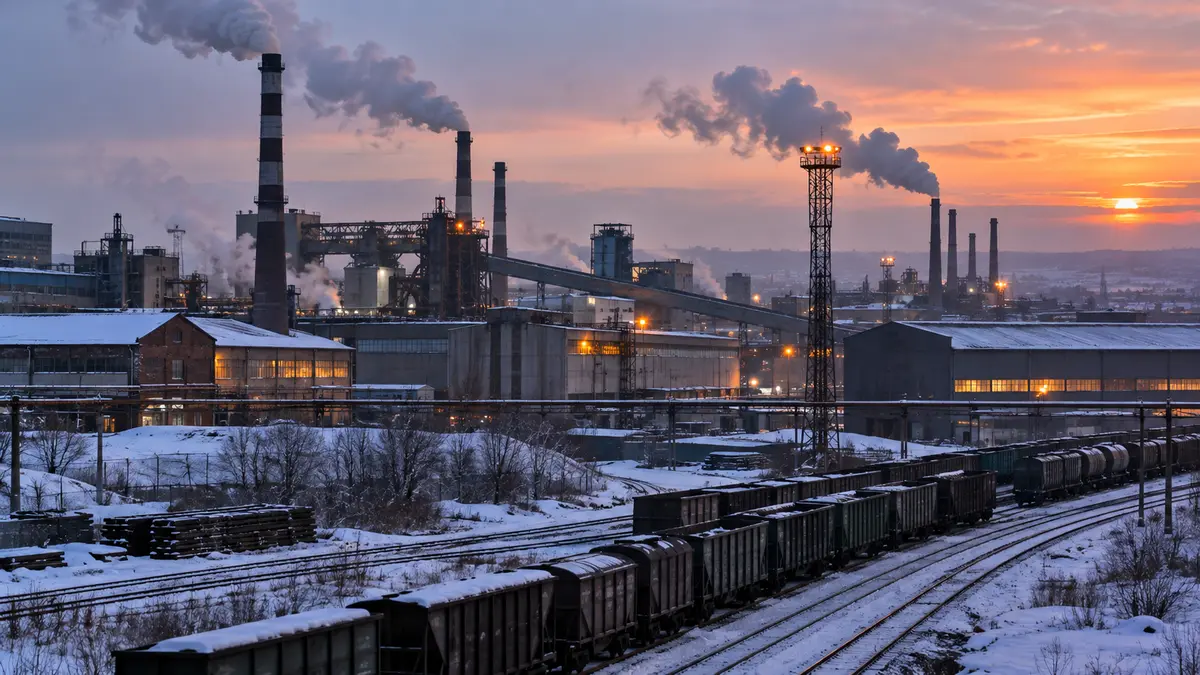
The Russian economy is entering the final quarter of 2025 in a state that analysts increasingly describe as a controlled deceleration. After two years of unusually rapid growth, the pace of expansion is fading almost to zero, and the structure of that growth has narrowed to a handful of industries tied to state orders. On 29 October, analysts at Renaissance Capital presented an updated macroeconomic forecast in which the landing of the economy of Russia in 2025 is described as 'somewhat hard'. Their central conclusion is blunt: the engine of industrial production today is the group of industries oriented toward defence orders and the state sector, and without them the economy 'in the best case will not grow' in the fourth quarter. The full forecast, with comments from economists, was published by the magazine Expert.
The arithmetic of the slowdown is stark. Over the first eight months of 2025, the economy grew by 1%, but by the end of the year the pace is expected to slow to 0.8%, according to Renaissance Capital's estimates. GDP is not projected to return to growth of more than 1% before the second half of 2026. These expectations fit inside the current version of the Bank of Russia's medium-term forecast, updated on 24 October: the regulator works from a range of 0.5–1% for 2025 and 0.5–1.5% for 2026. At the same time, the central bank for the first time this year allowed that in annual terms growth in the fourth quarter could turn into a decline — within 0.5%. For an economy that until recently posted expansion several times faster, the very discussion of a quarterly contraction marks a turning point.
To understand what this turning point is worth, it helps to recall how quarterly statistics work. Gross domestic product is the total value of all goods and services produced in a country over a period; its dynamics are estimated by the national statistics service from data on industry output, investment, consumption and foreign trade. Annual growth rates compare the volume of production with the same period a year earlier, which is why even zero growth in one quarter can coexist with a positive result for the year — and vice versa. That is precisely why the central bank's wording about a possible decline 'within 0.5%' in annual terms for the fourth quarter is not a forecast of catastrophe, but an acknowledgement that the economy has approached the boundary where growth turns into contraction. Exactly where that boundary will run will be decided in the final weeks of the year.
The budget is no longer the engine
The most important shift of the year is fiscal rather than monetary. The budget is ceasing to be a factor that supports economic growth, Renaissance Capital's chief economist Andrei Melashchenko told journalists. In the coming quarters, the dynamics of GDP will depend on the same industries that made the key contribution to high growth rates last year — the sectors in which the role of defence orders is large. 'In September we saw that things are not entirely smooth there either; growth rates there have slowed,' Melashchenko noted. He did not rule out that the dip is connected with a shift in the timing of project deliveries and similar factors. 'If there is a surge in output at the end of the year, there is a chance that GDP will not be negative in the fourth quarter,' the chief economist of Renaissance Capital concluded.
Why does the withdrawal of budget support matter so much? In a modern economy, government spending works through a chain of effects. Money paid to suppliers of goods and services becomes the revenue of enterprises, which in turn pay wages, taxes and dividends; wages become household consumption, and consumption becomes the revenue of other companies. Economists call this chain the multiplier effect: one unit of budget spending generates more than one unit of total demand. When such spending grows quickly, it lifts the entire economy; when it stabilises or contracts, the lift disappears — and the economy is left with the underlying demand of households and businesses, which in 2025 is being deliberately cooled by monetary policy.
The defence sector adds a further layer. Orders for military production do not only load the factories that fulfil them directly. They create a multiplier effect that spreads to adjacent industries — machine building, metallurgy and the chemical industry — and through them the economy retains some potential for growth, said Nadezhda Kapustina, professor at the department of economic security and risk management of the faculty of economics and business at the Financial University under the Government of the Russian Federation. In her words, this effect, even if only partially, compensates for the weakness of other sectors, which are under pressure from high interest rates and compressed margins.
Here lies the main structural vulnerability of the moment. The more growth leans on a single type of demand — the state order — the more sensitive the whole system becomes to disruptions in its execution. The shift in project delivery deadlines that Melashchenko mentions is not a technical detail: in an economy where defence and state-linked industries carry the main load, moving output from one quarter to another directly changes the quarterly GDP figures. Hence his cautious wording that a surge in output at the end of the year could keep the fourth quarter above zero — and the central bank's equally cautious allowance of the opposite scenario.
In other words, two terms fall out of the growth equation at once: the budget impulse, which is weakening, and the credit demand that has become more expensive because of high interest rates. What remains — the output of the defence sector, consumer purchases and net exports — has to keep the economy afloat on its own. That is why the question of the fourth quarter has become the main macroeconomic story of the autumn.
Consumer demand and the VAT factor
Not every analyst agrees that the fourth quarter will end in contraction. A recession in the fourth quarter is unlikely to happen thanks to a modest but noticeable revival of consumer demand, which is being pushed along by the increase of the value added tax to 22% from 2026, noted Alexander Shirov, director of the Institute of Economic Forecasting of the Russian Academy of Sciences, in a conversation with the magazine Expert. 'Together with the contribution of the defence sector, this will be enough to stay above zero [in terms of GDP growth rates],' he said.
The logic behind the VAT effect is a familiar one in economics. When households know that prices will rise from a certain date because of a tax increase, part of them brings purchases forward, buying durable goods and big-ticket items in advance. This creates a temporary wave of demand in the months before the change — a wave that then recedes. For the fourth quarter of 2025, such a wave, combined with the output of the defence sector, may be just enough to keep annual growth slightly positive. It is a fragile kind of support: it borrows demand from the future rather than creating it.
It would also be wrong to claim that state defence orders are the only driver of the economy, stressed Victoria Pavlyushina, partner at the Agency for Transformation and Economic Development (ATRE). According to Rosstat data for the first half of 2025, among manufacturing industries the highest growth rates were shown by the production of fabricated metal products, as well as of other transport vehicles and equipment. According to ATRE's observations, in the medium term a tangible contribution to GDP growth can be made by the IT sphere and other sectors supported by national projects of technological leadership, as well as by construction, transportation and storage. In other words, the economy is not a single machine driven by one lever; it is a set of engines running at very different speeds, and the question is which of them can take over when the strongest one slows down.
The ruble: the main surprise of the year
Alongside growth, the currency market has produced the biggest forecasting error of 2025. The ruble is the 'main surprise of the year' for analysts, and its weakening is 'delayed', Renaissance Capital's chief economist Andrei Melashchenko stated. In April, the Ministry of Economic Development forecast an average annual dollar rate of 94.3 rubles, and the market shared that estimate. Now, in the base case, analysts expect 84.3 rubles per dollar on average for the year, and the expected weakening to 93.5 rubles is being postponed to 2026.
What explains such a stubborn currency? The exchange rate of a country's currency is shaped by the balance between the foreign currency that exporters earn and sell, and the foreign currency that importers need to buy. When export revenues are high, imports are squeezed by weak domestic demand, and the central bank itself sells foreign currency, the national currency strengthens. In the current case, a decisive role is played by the central bank's currency operations, which are being scaled back. The expected weakening should be influenced by the Bank of Russia's retreat from active currency sales. If now, by Renaissance Capital's estimate, the monthly volume of operations is about $2.7 billion in yuan, next year it will fall by at least half.
Translated into the current exchange rate, the central bank may cut currency sales by more than $20 billion over 2026, agreed Rodion Latypov, chief economist of VTB. He noted that this sum is more than half of the current account surplus that the regulator forecasts for next year — about $27 billion. The current account surplus is, in simplified terms, the difference between the foreign currency the country earns from exports and the foreign currency it spends on imports; it is the fundamental source of supply of foreign currency on the domestic market. If the central bank stops adding its own sales on top of that surplus, the pressure on the ruble from the supply side weakens — and the currency should gradually give back part of its strength.
For the budget, the exchange rate is not an abstract indicator. A large part of government revenue comes from taxes and duties on exports of oil and gas, which are priced in foreign currency. A stronger ruble means fewer rubles of revenue per dollar of export earnings, which tightens the budget precisely when spending support is being withdrawn. Under sanctions and high geopolitical risks, 80–85 rubles per dollar is optimal for the budget and the economy, provided the oil price stays in the range of $65 to $70 per barrel, said Svetlana Frumina, head of the department of world financial markets and fintech at Plekhanov Russian University of Economics, in a conversation with Expert. The link between the oil price and the comfortable exchange-rate corridor is direct: cheaper oil narrows the range of rates at which the budget remains balanced.
The myth of the 'balanced rate'
One of the recurring themes of the year has been the search for a 'balanced' exchange rate — a level that would suit exporters without fuelling inflation. The economists surveyed by Expert assess this concept with scepticism. 'A weakening of the ruble relative to any levels will be beneficial for exporters, just as a strengthening will be beneficial for importers. This statement is true both at a rate of 100 rubles per dollar and at a rate of 70 rubles per dollar,' summed up Rodion Latypov of VTB.
The scepticism is well grounded. Exporters always prefer a weaker currency, because each dollar of their foreign earnings converts into more rubles; importers always prefer a stronger one, because their purchases become cheaper. There is no single rate that satisfies both sides at once — the 'balance' is always a political and macroeconomic compromise, not a market equilibrium. The inflation argument matters too: a sharp weakening raises import prices and feeds inflation, which is exactly what the central bank has spent the year fighting with high interest rates. That is why the regulator treats the currency as one more transmission channel of its policy rather than as an independent target.
What the fourth quarter will decide
The coming months will show whether the combination of factors — a late-year surge in defence output, a modest pre-VAT wave of consumer demand and a still-strong ruble — is enough to keep annual growth above zero. The stakes are not only statistical. A negative fourth quarter would be the first quarterly contraction in the current cycle and would confirm the 'somewhat hard' landing scenario; a slightly positive one would leave the picture of a managed deceleration intact, with growth concentrated in a narrow set of state-linked industries.
For policymakers, the lesson of 2025 is structural. An economy in which the budget is no longer the main engine, the currency is stronger than anyone forecast, and the defence sector carries a disproportionate share of growth has a narrower margin of safety than the headline growth figures suggest. The multiplier that runs from defence orders through machine building, metallurgy and chemicals keeps the system moving, but it does not create the broad-based demand that a peacetime economy needs. And the deferred weakening of the ruble means that part of the adjustment is simply postponed to 2026 — along with the question of who will absorb it.
As the year closes, the Russian economy resembles a machine that has been deliberately slowed down: the gears are still turning, but the strongest of them — the ones connected to state orders — are carrying almost the entire load. Whether that is enough to avoid a contraction in the final quarter is the question on which the whole 2025 story now turns.
Key figures at a glance
- GDP growth slowing as the economy adjusts after a period of defence-driven expansion.
- Rising dependence of output and investment on defence and state spending.
- Labour market tightness and high interest rates weighing on civilian sectors.
- Analysts caution that the current growth mix may prove difficult to sustain.

















Leave a comment
Your comment is awaiting moderation.