Where microfactories fit the production system
Microfactory suitability depends on the complete production route, not just the speed of a demonstration cycle.
A small factory can shorten the distance between a design change and a usable component, but size alone does not determine whether it belongs in a production system. The relevant questions concern product variety, batch size, qualification and the work that happens after fabrication. Microfactories become easier to assess when those questions replace a simple contest between small and large plants.
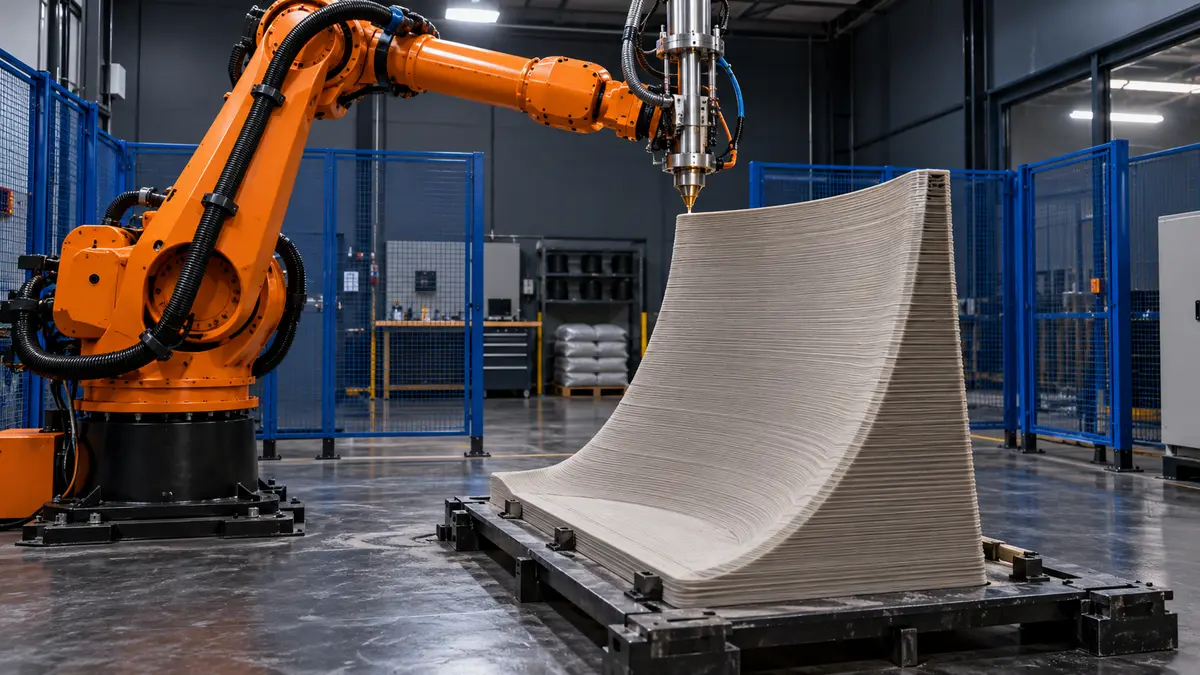
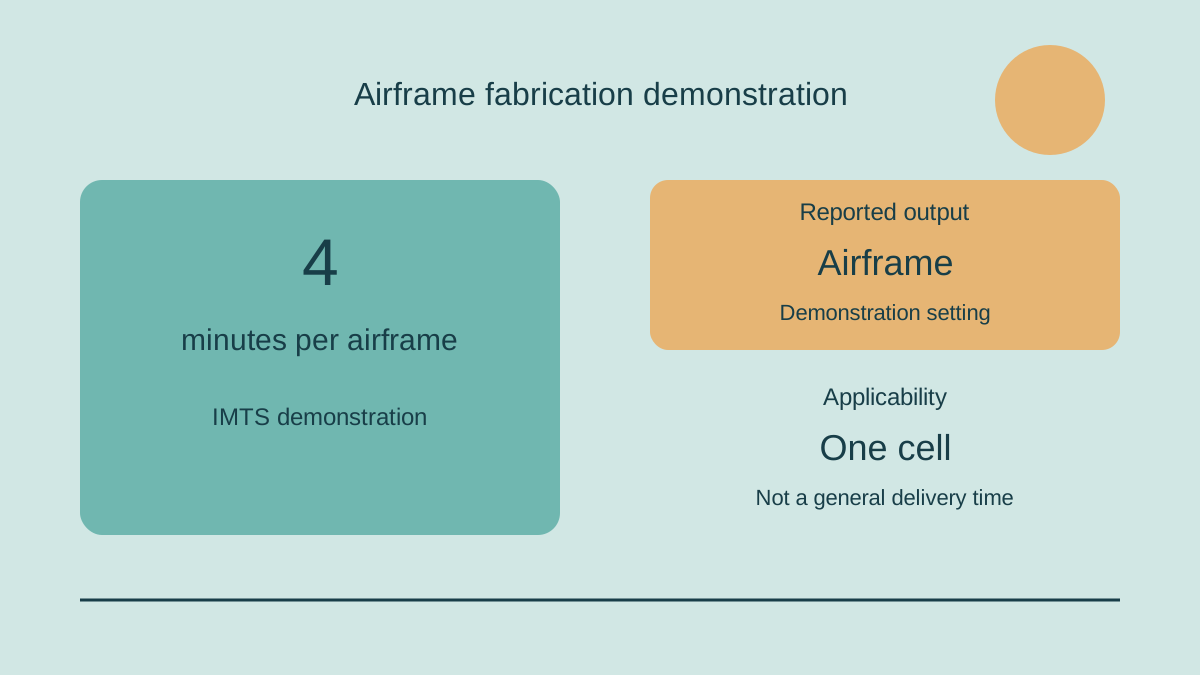
Manufacturing Dive’s report of 1 October describes modular facilities using robotics, additive manufacturing and connected production. It discusses Caracol’s high-mix, low-volume approach and an automated manufacturing demonstration at the International Manufacturing Technology Show in Chicago, United States. The demonstration produced quadcopter airframes every four minutes. That is a reported demonstration cycle, not a guarantee that any microfactory can deliver every qualified component at the same rate.
Start with the product family rather than the building
A production system should begin with the parts it must make. A business with frequent design changes and small batches faces a different problem from one producing a stable design in a long run. In the first case, flexibility and the time needed to prepare another variant can be important. In the second, a dedicated line may spread its preparation and equipment costs over many identical units. Neither situation can be judged from floor area alone.
The source makes this boundary explicit through Brett Conner of the Society of Manufacturing Engineers: microfactories may fit high-mix work but are not necessarily the best choice for low-mix, high-volume applications. That is a use-case distinction rather than a claim that one method always costs less. A buyer should therefore define the relevant product family, the anticipated mix and the acceptance requirements before asking whether a compact automated cell is commercially attractive.
Product families also reveal which operations can actually share equipment. Two parts can look similar while requiring different materials, tolerances or post-processing. A flexible machine does not automatically create a flexible end-to-end process if one downstream operation remains dedicated to a narrow specification. Mapping the entire family helps avoid buying a versatile fabrication system whose output then waits at a less versatile finishing or inspection stage.
The fabrication cycle is only one part of lead time
The four-minute airframe demonstration is a useful illustration of rapid fabrication in a defined setting. It should remain attached to that product and demonstration. A usable component can require design approval, material preparation, fabrication, cooling, finishing, inspection and delivery. Some processes require fewer stages, others more. The demonstration does not establish that all those activities were completed within four minutes for an arbitrary customer order or that the result applies to every material.
For a purchaser, lead time begins when the requirement is defined and ends when an accepted part is available for use. A short machine cycle may have limited effect if design clarification occupies most of that interval. Conversely, a somewhat slower fabrication method can be valuable if it eliminates a long transport or scheduling wait. The useful comparison concerns the complete accepted component, with the same starting point and the same acceptance condition.
That comparison should preserve the distinction between working time and waiting time. A component might spend little time on a machine and much longer awaiting an inspection slot or a missing approval. Reducing fabrication time alone cannot remove that queue. A microfactory proposal is therefore more credible when it identifies the current constraint and explains which activity the new system changes, rather than presenting one fast cycle as a complete lead-time forecast.
Digital design needs a controlled route to production
The ability to produce an object from a digital model can reduce some preparation steps, but it also makes control of the model important. A shop needs to know which revision is approved, which material and process it assumes, and what checks are necessary before release. Producing the wrong revision quickly is still a failure. Digital connectivity becomes useful when it carries the relevant design authority and acceptance information alongside the geometry.
A distributed network makes this responsibility more visible. If several cells can receive the same design, the business needs to establish whether they use comparable settings and whether their outputs meet the same requirements. Shared files alone cannot prove equivalent production. Equipment condition, calibration, feedstock and operator procedures can differ. These are general evaluation questions rather than problems demonstrated at a named Caracol installation; the report does not publish a network-wide qualification dataset.
A sound release record links the approved model to the production run and the resulting inspection. That record can help identify which units need review when a design changes. It can also prevent a later correction from silently replacing the file used for an earlier batch. The objective is not paperwork for its own sake, but a dependable connection between what was intended, what was produced and what the customer accepted.
Material suitability comes before a promise of substitution
The report describes additive fabrication using polymers, composites and metals. Those categories should not be treated as interchangeable simply because they can all form a physical object from a model. A component’s temperature, load, wear and environment determine what it must withstand. Geometry is only one part of the requirement. A substitute made quickly from an unsuitable material may solve an appearance problem while leaving the functional problem unresolved.
Qualification therefore needs to match the component’s intended role. A visual prototype, a production tool and a load-bearing part may require different evidence. The source’s examples demonstrate the scope of possible applications without authorising a particular substitution. This article does not claim that a printed part is suitable for any named aircraft, vessel or industrial machine. That judgment belongs to the relevant design and quality process using evidence for the actual component.
Material availability is another boundary. A local fabrication cell still depends on feedstock, consumables and maintenance items. Moving production closer to the customer can change the supply chain without eliminating it. A proposal should identify those dependencies and how long the cell can operate with confirmed supplies. Otherwise, a business may exchange a long wait for a finished part for a long wait for the material needed to make it.
Post-processing can become the limiting operation
Fabrication creates an object, but the object may need additional work before use. Depending on the process and requirement, that work can involve surface finishing, machining, cleaning or inspection. The exact route must be established for the product; it cannot be inferred from the label “microfactory”. If several variants share a fabrication cell while all depend on one finishing resource, that resource can determine the actual output of the system.
Planning should therefore count capacity at each required stage. A fast first operation does not make the whole line fast if the next operation cannot keep pace. The effect may be a queue of partly completed objects rather than more accepted products. Small facilities can make these connections easier to see because the process is compact, but compactness itself does not balance the workload or establish adequate finishing capacity.
It is also useful to distinguish work performed inside the cell from work sent to another supplier. Outsourced finishing may be entirely appropriate, but it changes the lead-time claim. A local fabrication step followed by distant processing is a different model from a complete local service. The commercial description should make that boundary visible so customers can evaluate the actual delivery route rather than assume that every operation happens in the small facility.
Flexible capacity needs a realistic utilisation measure
A machine that can make many designs does not spend all its time producing accepted output. Changeovers, material preparation, maintenance, checks and scheduling can occupy part of the available period. A utilisation measure should therefore specify what activity it counts. High machine activity is not necessarily high customer value if it includes repeated unsuccessful runs or work waiting for a final acceptance step.
The value of flexibility can also lie in avoiding a delay rather than maximising the number of units made. A small urgent batch might justify reserving capacity even when the equipment could otherwise run a longer order. That is a commercial choice involving service commitments and cost. It should be explained as such, rather than hidden inside a claim that every hour without production is waste or that the smallest plant is always the most efficient.
Adding modules as demand develops can potentially make investment more gradual, as the source discusses. However, another module adds useful capacity only if shared resources can support it. Power, finishing, inspection, digital coordination and staffing may also need to expand. The decision should follow the constraint in the complete process. Buying another fabrication unit will not necessarily increase accepted deliveries when a different stage already limits them.
The skill requirement is broader than machine operation
Conner describes hybrid skills combining robotics, machining and post-processing. That observation fits the structure of a compact automated facility, where one team may need to understand several connected stages. Operating the robot is important, but so are recognising a material problem, managing a design revision and deciding when an output needs further review. Automation changes the work rather than removing every need for judgment.
Training should therefore connect with the actual product and quality route. A person can learn an interface without yet being able to identify when the process is producing an unacceptable result. Clear escalation and release responsibilities remain useful alongside technical skills. The report does not provide measured staffing requirements for every microfactory, so this article does not assign a universal number of employees or predict that a specific existing workforce can be replaced.
A network needs consistent evidence, not only connectivity
Several smaller facilities can potentially locate production closer to different customers. The benefit depends on whether orders can be assigned reliably and whether each site can demonstrate the necessary capability. A network map showing many locations does not establish that every location can make every part. Matching a job to a qualified cell is more important than assuming that geographic proximity alone creates a suitable supplier.
Shared records can support that match by showing equipment, materials, approved processes and inspection capability. They also need a clear update process so a change at one site is reflected before another order is assigned. The commercial promise becomes stronger when it identifies a verified capability at a defined location. That is more useful than a broad claim that a connected network can make any object anywhere.
The first order should test the whole promise
A pilot order is useful when it follows the same approval and delivery route expected in ordinary work. A demonstration may focus on proving that a shape can be produced, while a customer order must also establish that the shape meets its requirement and arrives when needed. Recording both the active work and the waits helps identify whether the proposed system solves the original constraint. It also prevents a technically successful trial from becoming an unsupported estimate of routine delivery performance.
The acceptance criteria should be agreed before the trial. Otherwise, participants can select whichever result looks most favourable after it finishes. A useful pilot can reveal an unexpected finishing need or show that a design needs revision. Those findings are valuable if they change the deployment plan. They should remain visible alongside successes, because the purpose is to establish a dependable production route rather than collect only the fastest isolated machine cycle.
The pilot result should also be discussed with the team that will accept regular deliveries. Its documentation and delivery requirements can differ from the demonstration team’s criteria. Agreement beforehand helps preserve a consistent meaning of “finished” at each stage of the future order.
What belongs in a practical evaluation
- The product family, expected variation and batch size.
- The complete route from approved design to accepted delivery.
- Material and qualification requirements for the intended use.
- The capacity of finishing and inspection as well as fabrication.
- The skills and responsibilities needed to operate the cell.
- The evidence required before another site can receive the same work.
These questions turn microfactory adoption into a decision about a defined production problem. They leave room for a compact cell to provide considerable value without treating it as a universal replacement for a large factory. The four-minute demonstration shows what a particular automated arrangement achieved in a particular setting. The broader commercial result will depend on how design, materials, qualification and delivery work together for the customer’s actual component.

















Leave a comment
Your comment is awaiting moderation.