British Airways A380 cabins and investment
The cabin refit sits within a wider service and engineering programme.
A different cabin mix
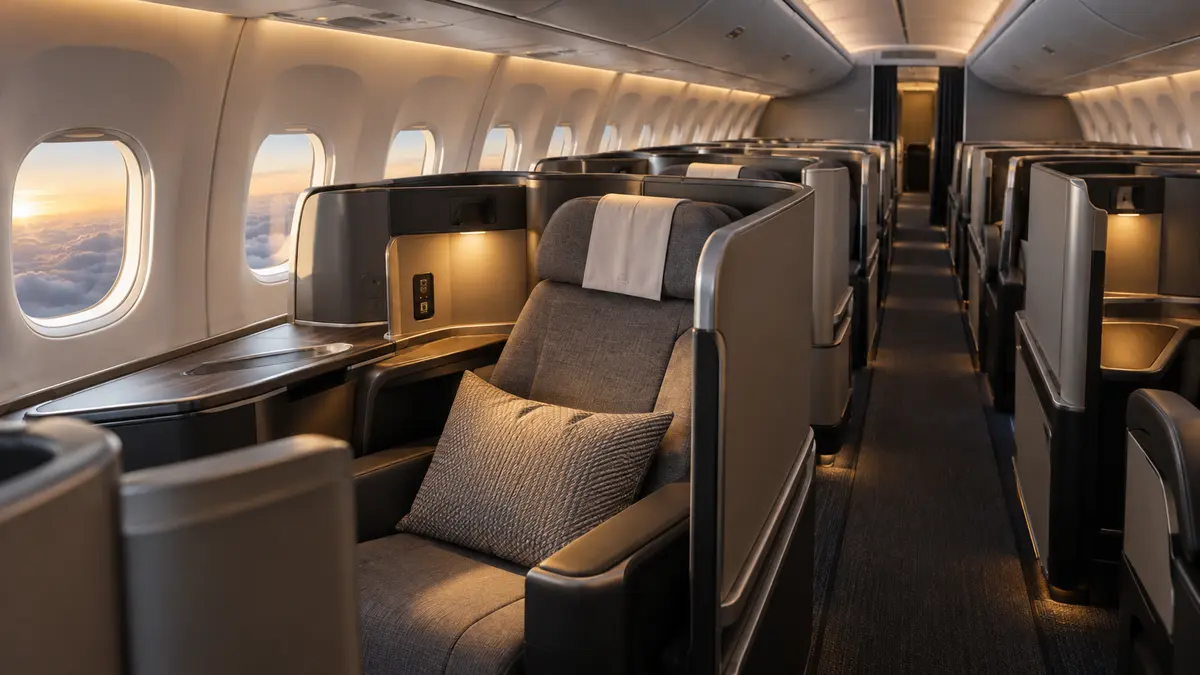
Travel Weekly reported on 7 October 2026 that British Airways plans to refit its A380 cabins. Business seats rise from 97 to 106, premium economy from 55 to 84, while economy falls from 303 to 215 and First from 14 to 12. The airline expects the first refitted aircraft in the coming months.
A product with an earlier starting point
The business cabin has a history that predates this announcement. In March 2019, British Airways introduced Club Suite for its new A350 aircraft, describing a one-two-one layout with direct aisle access and doors at individual seats. The specification included fully flat beds, an 18.5-inch entertainment screen and USB and computer power connections. The airline also described storage space as 40 per cent greater than in its earlier business product. These were features of the 2019 launch, rather than evidence that the A380 refurbishment has already entered service.
In November 2024, the airline presented its redesigned First seat. Its description included a 32-inch screen, a personal wardrobe and a wider sleeping surface. Customer feedback informed the rectangular bed shape. The release also identified a manufacturing chain: Collins Aerospace in Kilkeel, design agency Tangerine in London and leather supplier Muirhead in Glasgow. That announcement expected introduction in mid-2026. The October 2026 statement instead describes the first refitted aircraft as forthcoming; the earlier date belongs to the original plan and cannot be treated as confirmation of delivery.
The programme around the seats
A March 2024 programme announcement placed new products within a £7 billion transformation involving more than 600 initiatives. British Airways described work on its website and app, onboard messaging, short-haul interiors and lounges. It also announced 350 roles at Heathrow and a Connected Teams project using Microsoft technology to coordinate colleagues on the ground and in the air. The breadth of that programme matters when reading subsequent releases: each announcement describes a particular component, rather than providing a completion certificate for the entire investment programme.
The Miami lounge opening in October 2025 supplied an earlier example of the airline’s new interior concept. British Airways described a space of more than 13,000 square feet, designed with Gensler, with references to the city’s Art Deco architecture. Its account identified local food, a bar and a separate Concorde Dining experience. This was a specific airport facility with its own location and opening, distinct from the aircraft cabins now awaiting introduction. The lounge release provides background on the design programme without proving that every airport has received the same refurbishment.
The Dubai opening, also announced in October 2025, applied the concept to a different building. The airline described nearly 5,800 square feet in Terminal 1, with Gensler working alongside local contractor Al Tayer Stocks. Arches, reflective panels, marble and metalwork formed part of the interior description. Local menus and a Concorde Dining area accompanied the architectural changes. These details concern that lounge’s construction and service setting. They should remain attached to Dubai, rather than being transferred to the planned Heathrow facility or to the A380 cabin specification.
Seattle had a separate refurbishment milestone in February 2025. British Airways said the reopened lounge had a new bar and food-serving area, alongside spaces for First dining. Its description retained the building’s views over the airport, which it characterised as spanning 180 degrees. The announcement coincided with the airline’s account of 45 years of flying to Seattle. It is an example of refreshing an existing airport space, while the later Heathrow announcement includes a newly created lounge as well as redevelopment of an arrivals facility.
Airport projects have their own deadlines
The 5 October 2026 Heathrow release sets out three different projects. A Terminal 5 C Gates lounge is due to open at the end of 2028. An arrivals lounge redevelopment is scheduled to start in early 2027 and open by that year’s end, with 59 shower rooms. A new First check-in facility at Terminal 3, developed with American Airlines, is expected this winter. These are planned airport milestones.
Engineering capacity behind the programme
The maintenance network has its own investment history. In November 2024, British Airways announced plans to expand a bay at its Cardiff engineering facility so that it could accommodate the A350. The site had three bays, with work intended to create two fully flexible ones. The release described an existing workforce of 480 and a schedule beginning in 2025 with completion planned for 2026. Those details explain the announced scope of the engineering project. They do not establish that the work finished on time, or identify Cardiff as the location of every A380 conversion.
Another capacity announcement followed in February 2025, when British Airways said it had agreed to acquire Boeing’s maintenance, repair and overhaul facility at Gatwick. The plan envisaged a wholly owned operation called British Airways Engineering Gatwick, alongside the airline’s facilities in South Wales and Glasgow. Employees were to transfer following consultation, with the transaction expected in the second quarter. The statement records an agreement and intended transfer process. It should be read at that stage, rather than rewritten as evidence of a completed acquisition or of a specified A380 maintenance contract.
Ground equipment is a further part of the operational background. In March 2024, British Airways described investment at Heathrow in electric equipment, hybrids and vehicles using hydrotreated vegetable oil. More than 750 pieces of equipment were associated with the latter fuel. The release grouped zero-emission-in-use equipment, hybrids and that fuel category when describing a share above 90 per cent. That combined measure is not a claim that more than 90 per cent of the fleet was electric. The distinction preserves what the company actually reported about equipment and fuel.
Operations and the passenger experience
In May 2025, the airline connected a £100 million operational resilience investment with improved punctuality. Its announcement reported a Heathrow first-quarter on-time figure of 86 per cent and described technology used in forecasting and operational coordination. The figure is a dated company-reported performance measure, not a forecast for the new cabin’s operation. The release concerns the running of flights, while the A380 announcement concerns the product inside an aircraft. Both appear within the transformation programme, but the sources do not establish that replacing seats caused the reported punctuality improvement.
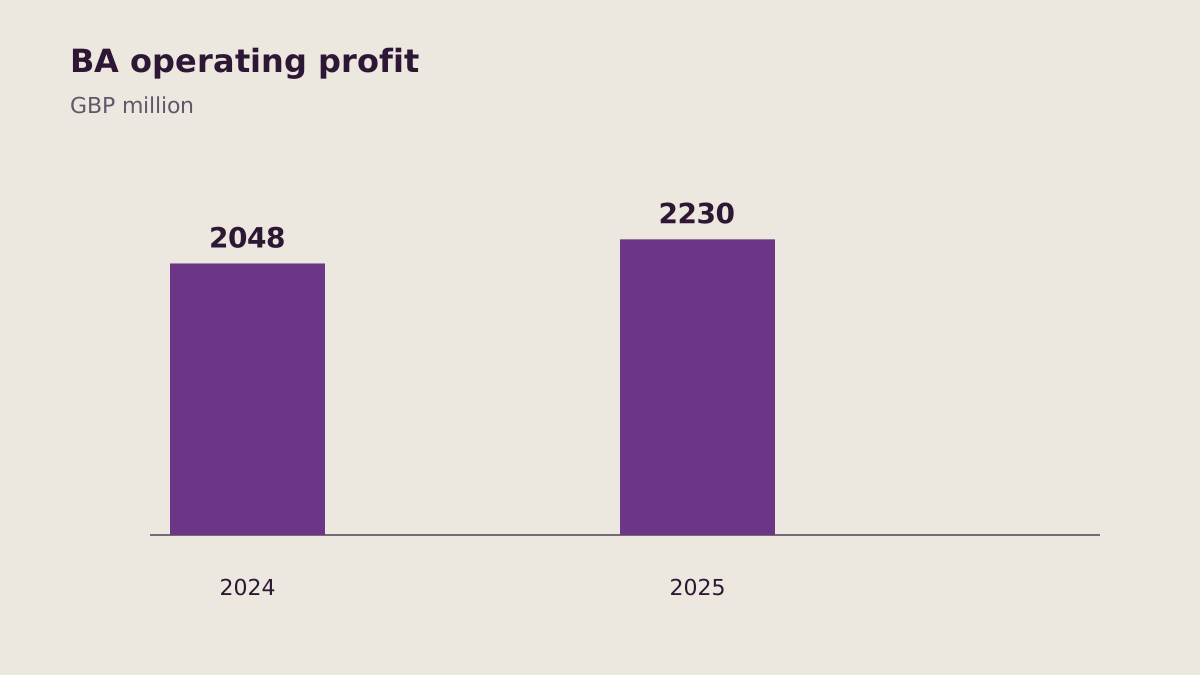
The financial context comes from a separate results statement published in February 2026. British Airways reported operating profit of £2,230 million for 2025, an increase of £182 million from the preceding year. It reported an operating margin of 15.2 per cent, up one percentage point, alongside a 1.7 per cent increase in flying. These are historical results for the airline. They are not a cost breakdown for the A380 project and do not measure the return on its new seats. The statement does not allocate those profits to particular cabin changes.
Connectivity follows another sequence
British Airways announced its Starlink agreement in November 2025, describing free connectivity for customers in every cabin and an intended start in 2026. The release emphasised a low-Earth-orbit satellite system and the ability to use multiple devices, including for streaming. At that point the agreement and proposed service were the news. A network-wide rollout had not been demonstrated by the announcement itself. The chronology matters because an agreement, an initial aircraft installation and completion across the fleet are separate events, even where they belong to the same connectivity programme.
The first-flight milestone came in March 2026. British Airways said a Boeing 787-8 flying to Houston was its first aircraft to operate with Starlink installed. That release also described a plan to fit the service across the fleet over the following two years. The Houston flight supplies evidence of an initial operating installation, with a distinct date and aircraft. It does not convert the two-year rollout plan into a completed fleet-wide service. Likewise, the first connected 787 is not evidence that every refurbished A380 already carries the same installation.
The entertainment library also changed through a separate partnership. In March 2026, British Airways announced an Audible offering with more than 250 hours of audiobooks and podcasts. Its examples included a full-cast Harry Potter production, Pride and Prejudice and Stephen Fry’s Ghost Stories. The release described a two-month trial offer and said more than 4,600 entertainment titles had been added since January 2025. Those figures describe content and the timing of additions. They are not specifications for the screen or seat hardware announced for the aircraft refurbishment.
Changes before the airport
In July 2026, the airline said the first phase of its new app rollout was under way after months of beta testing. The release described quicker access to boarding passes, push notifications and self-service booking changes. It also referred to saving passport details and travel-companion information. This is a later delivery stage than the March 2024 promise to overhaul digital services. The source nevertheless identifies a first phase, rather than asserting that every feature in the original transformation plan had been delivered to every customer on that date.
Service changes have separate histories
A tea partnership announced in April 2025 illustrates how a service change can have a timetable independent of an aircraft installation. British Airways selected Birchall following tasting tests and described staged introductions across long-haul cabins, Club Europe and the Heathrow short-haul buy-onboard offering. The statement put consumption in context with 37 million cups served onboard during 2024 and more than two million in lounges. These are historical service volumes. They do not show how many drinks a redesigned cabin will sell or imply that a tea supplier determines the new seat layout.
The airline’s March 2025 wine announcement described work with more than 1,300 First Service Specialist cabin crew. Training included wine knowledge with its Master of Wine, alongside a rotating selection of English sparkling wines. The named producers included Nyetimber, Gusbourne and Sugrue. This source concerns crew preparation and an earlier drinks programme, with individual introductions spread over time. It offers another dated part of the service background. It does not establish the menu on every future A380 flight or turn a planned wine introduction into a verified current onboard offering.
The journey is wider than a cabin
An assistance service announced in March 2025 addressed journeys from India to London. British Airways described complimentary support in Hindi, Punjabi, Telugu and Tamil, covering check-in, airport navigation, boarding and arrival or onward connections at Heathrow. The release identified staged availability across five Indian airports after trials supporting more than 500 customers. Its focus was help from trained colleagues for passengers with assistance requirements. That is a different service dimension from the number of premium seats, and the announcement should not be presented as a guarantee of the same assistance at all airports worldwide.
The uniform programme provides an older example of involving colleagues in service design. In January 2023, British Airways announced a collection by Ozwald Boateng intended for more than 30,000 employees. It described four years of development and participation by more than 1,500 colleagues. Practical testing included cold environments, while individual adaptations included touch-screen-compatible gloves and pockets for engineering tools. These details belong to the uniform project and its operational testing. They offer historical context for the airline’s approach to workplace design without demonstrating how the new A380 seats themselves were certified.
The aircraft’s longer history
The first British Airways A380 delivery was announced in July 2013. Airbus described the airline as the tenth operator of the type and the first in the United Kingdom, with that delivery beginning an order for 12 aircraft. Rolls-Royce Trent 900 engines powered the aircraft. Los Angeles and Hong Kong were identified for the initial long-haul network. This earlier delivery explains the age of the programme being refreshed in 2026. It does not mean that the currently announced seat configuration was part of the original aircraft delivery or had remained unchanged since then.
Cabin layout is also an engineering question
Airbus presented an A380 cabin-enabler package in April 2017, including a redesigned forward staircase. It described options intended to create additional usable cabin space and accommodate more seats. That was an industry design proposal presented years before this British Airways announcement. It is useful background on the relationship between stairways, floor layout and seating capacity. The source does not establish that British Airways selected that particular package. A description of a manufacturer’s available design option should not be substituted for an airline’s confirmed refurbishment specification.
A Singapore Airlines project supplies a separate example of an A380 retrofit reaching operation. Airbus announced in June 2019 that the first of 14 aircraft to receive the new cabin had entered service. The work brought existing aircraft toward the cabin standard of five newer deliveries and involved service bulletins, cabin kits, design work and on-site support with SIA Engineering Company. This is a documented project for another airline. It illustrates the scope of an earlier conversion, without identifying the suppliers, contract terms or completion timetable of British Airways’ current programme.
Airbus’s aircraft-modification service description sets out tasks that can accompany changes to cabins, systems and connectivity. It refers to modification kits, materials, tools, consumables and the management of parts, alongside support for carrying out work. This is a description of an offered service, rather than an announcement of participation in the British Airways A380 project. Keeping that boundary clear avoids attributing a contract merely because a supplier has relevant capabilities. The general service description provides technical context; the airline’s own project release remains the source for its confirmed scope.
An April 2024 Airbus account of preparing A350 cabin retrofits describes a workflow from an accepted technical and commercial offer to project coordination, design data, certification documentation, kits and service bulletins. It also discusses support during installation. The account concerns the A350 and is useful as a manufacturer’s explanation of its own process. It is not a technical specification for the British Airways A380. Aircraft type, operator and project stage should therefore stay visible when using it as background on how a cabin modification moves beyond the design presentation.
An independently documented conversion
Emirates reported in May 2026 that its first two-class A380 converted to a three-class layout had entered service on the Dubai–Birmingham route. The airline described work by 50 engineers, taking two months and 35,000 man-hours, with changes to partitions, galleys and electrical and plumbing systems. Those man-hours measure labour on that Emirates project, not the number of parts in British Airways’ aircraft. The distinction is essential when comparing refurbishment announcements: similarly sized headline numbers can refer to different units, different operators and different stages of completed work.
Reading the project milestones
- The first refitted British Airways A380 remains forthcoming.
- The Terminal 5 C Gates lounge is scheduled for late 2028.
- The March 2026 connected flight was a first installation milestone.



Leave a comment
Your comment is awaiting moderation.