Global Bond Markets Are Shaking Again: Why Yields Are Rising and Who Pays the Price
A fortnight of instability in government bond markets has pushed the 10-year US yield to 4.8% and the 30-year yield to its highest since 2008, as investors reassess US debt above $40tn, oil above $90 a barrel, a wave of AI-driven corporate borrowing and the end of Japan's deflation era — with knock-on effects for mortgages, budgets and developing economies.
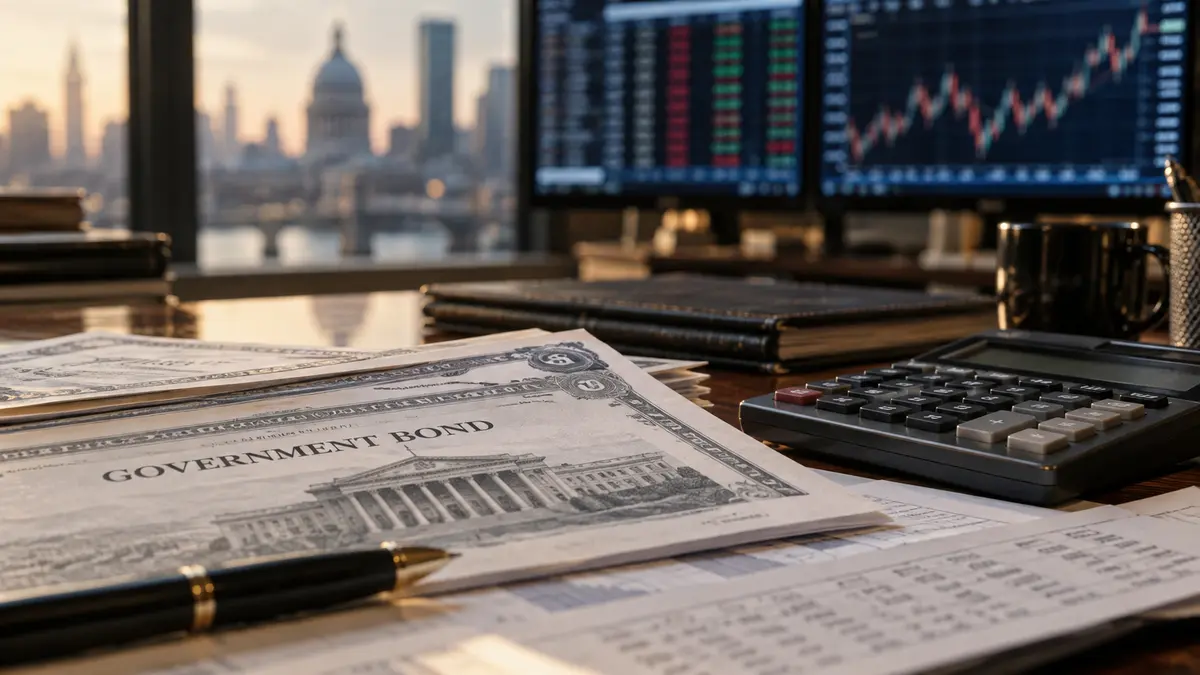
Over the past fortnight, a wave of instability has swept through government bond markets in the world's major economies, and its consequences are already reaching far beyond trading screens. The yield on 10-year US government borrowing climbed to 4.8%, up from 4.64% just ten days earlier, and at one point midweek the 30-year yield touched its highest level since 2008. What began as a reassessment of American public finances has spread into a global repricing of risk, with knock-on effects for millions of borrowers, from households with mortgages to governments drafting their next budgets.
Government bonds are the bedrock of the financial system. Their yields set the benchmark against which almost everything else is priced: corporate borrowing, bank loans, mortgage rates, the cost of financing a power station or a datacentre. When bond yields rise, the price of money rises with them. That is why a two-week wobble in the United States treasury market can end up changing the monthly payment on a family mortgage in another country.
It is worth pausing on the mechanics, because they explain why the alarm bells ring so loudly. A bond's coupon — the fixed interest payment printed on the certificate — does not change; what changes is the price at which the bond trades, and therefore the yield a new buyer earns. Long-dated bonds are the most sensitive: a thirty-year security locks in a return for three decades, so investors holding it are exposed to inflation and rate changes for a generation. When markets begin to doubt that inflation will stay contained, or that a government will keep its fiscal house in order, it is the long end of the curve that moves first and hardest. That is precisely what happened this week, when the 30-year yield touched its highest level since 2008 while the 10-year climbed more modestly.
A recalibration of US public finances
The immediate trigger, according to Neil Shearing, chief economist at the consultancy Capital Economics, was markets taking a fresh look at the state of American public finances. "There's been a recalibration," he said. Total US government debt has surged past $40tn, and annual deficits are forecast to run at around 6% of gross domestic product for the foreseeable future.
Such figures were long deemed barely to matter, given the status of US government bonds, or treasuries, as the ultimate safe-haven investment. But as the events that led up to the 2008 financial crisis revealed, things do not matter in the markets until they do. Shearing believes investors are now starting to see a more realistic reassessment of the fiscal pressure in the US. "What marks the US out is that there's not really an acknowledgment of the fact that there might be a problem. There's no plan," he said.
Russell Jones, a veteran bond market analyst at Llewellyn Consulting, put it in the language of experience: "The thing about economics is that often markets delay the judgment and, you know, you can't really time when they suddenly decide that that's enough." Markets can tolerate a problem for years and then reprice it within days.
It also matters who holds the debt. US treasuries are owned by a broad mix of domestic investors — pension funds, insurers, money-market funds and households — the Federal Reserve itself, and foreign central banks and institutions that park their dollar reserves in the deepest, most liquid market in the world. That foreign demand has historically been a stabilising force: when Americans save less, foreigners absorb the difference. But the more debt there is, the more the system depends on that appetite continuing. A recalibration, as Shearing calls it, is in part a question of whether the marginal buyer — the investor who must be persuaded to buy the next auction — will keep showing up at the old price, or will demand a higher yield to do so.
Politics has not helped. When Donald Trump was asked recently about the threat of rising interest rates on US government debt, he told reporters: "The ultimate intervention is our military. And if we have to use that, we will." His bellicose words did not soothe fractious bond markets, and his resumption of the bombing campaign against Iran only made matters worse. US treasury secretary Scott Bessent's recent fumbled attempts to intervene in financial markets — to help Tokyo prop up the yen and then to calm bond yields — have added to the sense that policymakers are panicking rather than steering.
Oil, inflation and the return of rate-rise fears
Layered on top of these fiscal concerns is a more immediate worry about inflation taking off again as a result of renewed hostilities in the Middle East. Oil prices have risen back above $90 a barrel since the US and Iran resumed tit-for-tat attacks. Higher energy prices feed directly into headline inflation, and that has increased expectations that central banks will have to raise interest rates — another factor that puts upward pressure on bond yields, because investors demand higher compensation for holding debt that will be eroded by inflation.
Every pronouncement by policymakers is now being closely scrutinised for clues. A key speech by the new Federal Reserve chair, Kevin Warsh, was read by markets as signalling a willingness to act against resurgent price pressures. The European Central Bank is expected to lead the charge with a rate rise, and markets are telegraphing higher borrowing costs across major economies. That includes the United Kingdom, where investors are now pencilling in three quarter-point rate rises over the next 12 months, and Japan, where the decades-long period of deflation and rock-bottom rates is finally coming to an end.
The interaction between policy rates and bond yields is worth spelling out. Central banks set the short end of the curve directly, through the rate at which they lend to commercial banks. The long end is set by the market, as a bet on where short rates, inflation and growth will go over the coming years. When investors start expecting rate rises rather than cuts, the whole curve shifts up: borrowing gets more expensive not just for overnight loans but for ten- and thirty-year commitments. That is why a single hawkish speech, or a single oil-price spike, can move mortgage pricing within hours — long before any central bank has actually changed its policy rate.

The AI debt wave: a new rival for investor cash
There is also a structural force at work that has little to do with geopolitics: the dramatic expansion of borrowing by AI "hyperscalers" in the US to help fund the massive planned build-out of datacentres. This surge in corporate bond issuance has offered investors an alternative home for their cash and raised questions about the market's ability to absorb so much debt simultaneously.
Recent calculations by the investment group Vanguard put the value of debt issued by five major tech companies at $135bn this year, up from an average of $35bn between 2020 and 2024. When a handful of technology giants issue more debt in a single year than they did in the previous five combined, the competition for savings intensifies, and the price of that savings — the yield — rises. Governments now have to compete with the world's most creditworthy corporations for the same pool of capital.
Some economists see an even more fundamental explanation for an upward shift in borrowing costs: the growing prevalence of inflationary shocks, not only as a result of geopolitical chaos but because of the climate emergency. Economists including the Bank of England policymaker Swati Dhingra have argued that increasingly regular shocks from extreme weather events and the resulting economic upheaval could lead to structurally higher interest rates over the coming decade. If that thesis is right, the current episode is not an aberration but a preview.
Why small moves in yields now hurt so much
Whatever the causes, the impact is already rippling out worldwide. Public borrowing has increased dramatically in recent years as policymakers stepped in to cushion consumers against pandemic shutdowns, wrestled with sharply higher energy prices after Russia's 2022 war in Eastern Europe, and stepped up defence spending. That means small changes in global interest rates can have an outsized impact on government budgets.
In the UK, £1 in every £12 of public spending already goes on debt interest. Prime minister Andy Burnham was pressed this week by opposition leader Kemi Badenoch about the rising cost of government borrowing. Higher yields on gilts, as UK government bonds are known, will feed through into predictions of higher interest costs for the Treasury ahead of new chancellor John Healey's autumn budget.
David Aikman, director of the National Institute of Economic and Social Research, urged the government to use the opportunity to implement spending cuts and/or tax increases to help insulate the UK from higher borrowing costs. "There will be a lot of talk about the fiscal rules. I think that's slightly missing the point," he said. "The big point here is we've just got a lot of debt, whether you're missing the rules or not. And it means we're really vulnerable."
Australia: a debt milestone at the wrong moment
On the other side of the world, Australia's policymakers have been wrestling with similar challenges. Bond yields have breached 15-year highs just days after the country passed A$1tn in government debt. The timing of the two milestones comes at a difficult moment for a Labor government under pressure to rein in historically high levels of spending, while falling house prices in a property-obsessed nation are adding to a mood of discontent. Bets have firmed that the Reserve Bank of Australia could deliver another interest rate hike later this month to tame stubbornly high inflation.
Treasurer Jim Chalmers has been at pains to highlight Australia's relatively strong budget position internationally: the country's debt is equivalent to about half the size of the economy, which pales against other advanced nations, and the commonwealth runs deficits of less than 1% of GDP. But Chris Richardson, an independent budget expert, said Australia's government indebtedness, while not "bad by world standards", was still a lot of debt. "And the higher cost of money means the difficult choices that were there already are that much harder," he said.
The most exposed: developing countries
For developing countries, these issues are all the more urgent. The International Monetary Fund warned earlier this year that these economies had become more exposed to the risk of higher interest rates, because of the growing importance of lending from short-term investors such as hedge funds, which tend to be more flighty during periods of market volatility.
Matthew Martin, of the advocacy group Development Finance International, said: "A lot of these countries are very near the edge, and if they have to go back to the markets and refinance another bond at 1% or 2% higher than it was before, that will mean even less money to spend on climate action, health and education." For poorer governments, every percentage point of yield is a direct subtraction from schools, hospitals and adaptation spending.
Beyond treasuries: mortgages, companies and private equity
If higher yields are sustained, the effects will be felt far beyond the world's treasuries, muddying the maths for corporate investment and putting upward pressure on mortgage rates, which in the UK have already started to rise. Aikman argued that corporate balance sheets worldwide look less shaky than before the global financial crisis — "We're not in the place we were in the run-up to 2008," he said — but he pointed to "pockets" of concern, including the huge scale of debt-fuelled private equity projects that could prove vulnerable in a world of higher rates.
There is one more channel through which bond yields reach ordinary people: pensions and insurance. Pension funds and life insurers hold vast portfolios of government bonds because their liabilities — the promises to pay retirees for decades — are long-dated and must be matched with long-dated, reliable assets. When yields rise, the value of existing bond holdings falls, creating paper losses on balance sheets; when yields stay high, the cost of buying new annuities and funding new promises changes too. None of this means a crisis is inevitable — Aikman's point that corporate balance sheets are healthier than in 2008 stands — but it does mean that the bond market's mood is not an abstraction. It is written into retirement incomes, insurance premiums and the borrowing capacity of the state, all at once.
By the end of the week, the sell-off sweeping global bond markets appeared to have eased, for now. But it left yields at levels significantly higher than three months ago, and delivered a painful reminder to policymakers that in globalised financial markets their plans can be buffeted by forces far beyond their control.
None of this is without precedent. In the 1990s, traders coined the phrase "bond vigilantes" to describe investors who discipline governments by selling their debt and forcing yields up whenever fiscal policy looks reckless. The lesson of that era — and of the European debt crisis a decade later — is that markets do not need a formal default to punish a government; they simply charge it more to borrow, and the compounding cost of that premium does the damage over time. What is different today is the scale: with public debt ratios far higher than in the 1990s across the advanced world, the same market discipline bites harder and faster.
What to watch next
- Whether the ECB follows through with a rate rise and how markets price the path of US, UK and Japanese policy rates over the next year.
- Whether oil stays above $90 a barrel and whether Middle East hostilities continue to feed inflation expectations.
- The scale of corporate bond issuance by technology hyperscalers, and whether the market can absorb it without pushing government yields higher still.
- How the UK autumn budget responds to a debt-interest bill that already consumes £1 in every £12 of public spending.
- Whether developing economies can refinance maturing debt before short-term investors demand a much higher price for holding it.
The bond market is the quiet machinery of the global economy, and this fortnight it has made a lot of noise. The question now is whether the repricing settles at a permanently higher level — or whether policymakers, in Washington, London, Tokyo and Canberra, can convince investors that there is, after all, a plan.

















Leave a comment
Your comment is awaiting moderation.