Japan Ends the World's Only Negative Rates Regime: Inside the Bank of Japan's Historic Pivot — and Why It Is Not the Start of a Hiking Cycle
The Bank of Japan raised short-term rates from -0.1% to around 0-0.1% — its first hike since 2007 — scrapped yield curve control and stopped buying ETFs, ending the world's only negative rates regime in place since 2016. Governor Kazuo Ueda says the virtuous wage-price cycle is taking hold after spring negotiations delivered a 3.7% base-pay rise, but promises accommodative conditions will be maintained as the yen slides beyond 150 to the dollar.
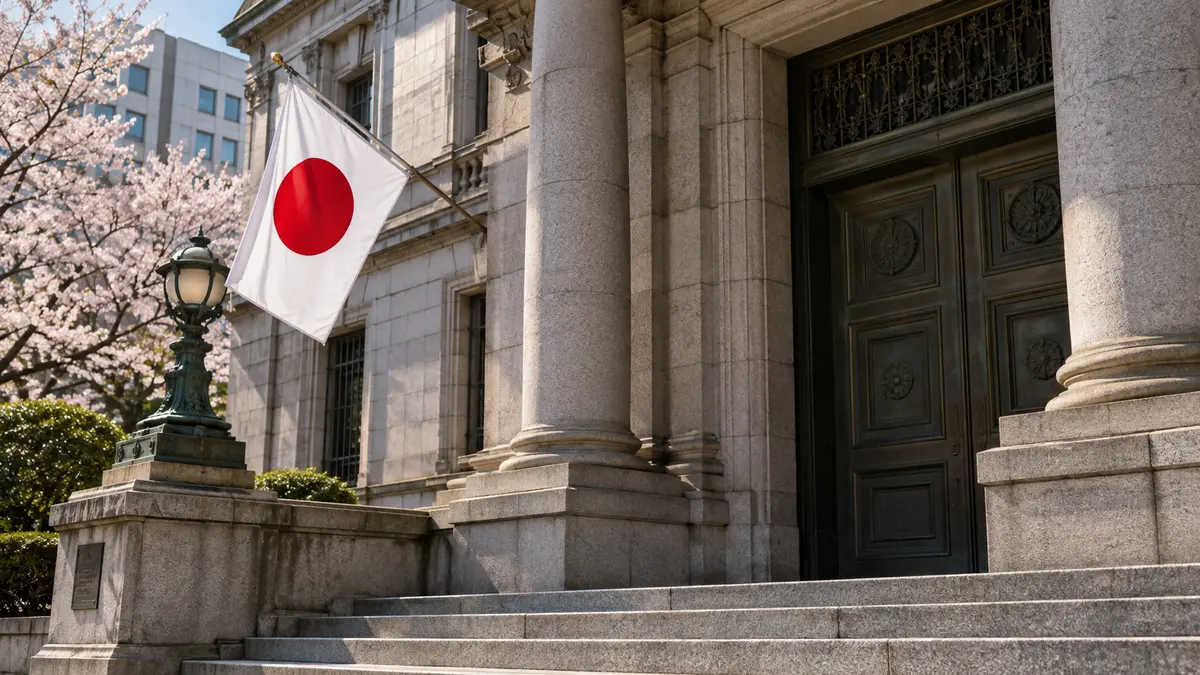
On 19 March 2024, the Bank of Japan did something it had not done in seventeen years: it raised interest rates. At the end of a two-day policy meeting, the central bank lifted its short-term policy rate from minus 0.1% to a range of around 0% to 0.1%, ending the world's only negative interest rate regime, which had been in place since 2016. In the same decision, the bank abolished its radical yield curve control framework for Japanese sovereign bonds, stopped buying exchange-traded funds and Japanese real estate investment trusts, and pledged to phase out its purchases of commercial paper and corporate bonds within about a year.
For Japan, the world's fourth-largest economy, the move is the sharpest pull-back anywhere from one of the most aggressive monetary easing exercises of the past few decades — and a symbolic line in the sand: the last major central bank that had pushed borrowing costs below zero has conceded that the era of fighting deflation with extraordinary tools is coming to an end. Yet the bank's message is deliberately not hawkish. Governor Kazuo Ueda and his colleagues made clear that they are not about to embark on a run of aggressive rate hikes, and that accommodative financial conditions will be maintained for the time being because growth at home remains fragile. That is the central tension of the decision: a historic normalisation that is simultaneously a promise not to normalise too fast.
Markets were not caught unawares. Over the week before the meeting, local Japanese news reports and preliminary results of the annual spring wage negotiations had fanned speculation that the bank would act in March, a month earlier than its April gathering. Still, the reaction was telling: the yen weakened sharply beyond 150 to the dollar, long-term bond yields slipped, and the Nikkei stock index ended slightly higher after a volatile session. Investors, in other words, heard exactly what the bank meant — the end of an era, not the start of a tightening cycle.
What exactly changed in the BOJ's policy framework
The decision rewrote almost every pillar of the unconventional toolkit that the country had assembled over decades of struggle against falling prices. The short-term rate increase was the headline, but the accompanying changes matter just as much for understanding where policy is going:
- The short-term policy rate was raised to around 0% to 0.1% from minus 0.1% — the first interest rate increase since 2007. The negative rates regime itself had been in place since 2016.
- The yield curve control policy for Japanese government bonds was abolished. Under that framework, the central bank had targeted longer-term interest rates by buying and selling bonds as necessary.
- Government bond purchases will nonetheless continue at broadly the same amount as before — currently about 6 trillion yen per month — and the bank promised nimble responses, in the form of increased bond purchases and fixed-rate purchase operations, if long-term interest rates rise rapidly.
- Purchases of exchange-traded funds (ETFs) and Japan real estate investment trusts (J-REITs), a hallmark of the bank's easing programme, were stopped outright.
- Purchases of commercial paper and corporate bonds will be scaled back gradually, with the aim of stopping the practice in about a year.
Governor Ueda was candid that the clean-up is far from finished. 'As for the future, we will at some point eye shrinking our balance sheet given we've ended our extraordinary monetary easing. But we can't specify now when that will happen,' he told reporters. He described the bank's holdings of government bonds and ETFs as 'remnants of the extraordinary monetary easing scheme', and deferred questions about the impact of its unorthodox policies until an ongoing internal review is completed.
The architecture of the decision reveals how carefully the bank intends to tread. It moved the price of money off zero while leaving the quantity of support broadly unchanged: rates are up, yet bond purchases continue at roughly the same monthly pace, with an explicit promise to step in if yields spike. Normalisation, in this framing, is not tightening — it is the removal of an emergency setting while the rest of the emergency machinery stays plugged in and running.
Why now: the wage-price virtuous cycle finally looks real
The trigger for the historic shift was not inflation itself — it was wages. The annual 'shunto' spring wage negotiations between Japanese companies and their unionised workers had so far yielded a weighted average 3.7% spike in base pay, according to the first provisional update published on the Friday before the meeting by Rengo, the country's largest federation of trade unions. That result is even more robust than the previous year's gains, which had been the steepest increase in three decades.
Ueda had repeatedly said that the outcome of this year's shunto negotiations would be key to achieving sustainable price increases. The bank's theory of the case is a virtuous spiral: higher salaries feed domestic demand, domestic demand fuels inflation, and inflation that is generated at home rather than imported from abroad becomes self-sustaining. In its statement, the bank noted that services prices have continued to increase moderately, partly due to the moderate wage increases seen thus far.
The language of the official statement spelled out the judgment that produced the decision: as recent data and anecdotal information gradually showed that the virtuous cycle between wages and prices had become more solid, the bank judged it had come in sight that the price stability target would be achieved in a sustainable and stable manner toward the end of the projection period of the January 2024 outlook report.
Those carefully chosen words matter. The bank did not declare that 2% inflation has been achieved; it declared that the target has 'come in sight' by the end of its projection period. Policy acted on a forecast, not on a finished fact — which is precisely why the accompanying guidance is so cautious, and why Ueda kept stressing at his press conference that there is still some distance for inflation expectations to travel before they reach 2%.

Inflation had been above target for more than a year — but it was treated as imported
On the surface, the timing looks late. 'Core core' inflation — the measure that strips out both food and energy prices — had exceeded the bank's 2% target for more than a year before the decision. Yet the central bank had barely budged from its ultra-loose monetary policy posture throughout that stretch, because policymakers viewed the price increases as largely imported: driven by global commodity costs and a weak currency rather than by home-grown demand.
What changed the assessment was the accumulating evidence that price rises were becoming domestic. 'The likelihood of inflation stably achieving our target has been heightening ... the likelihood reached a certain threshold that resulted in today's decision,' Ueda said at his press conference after the decision.
He then offered the intellectual core of the whole strategy. Looking across a timespan of five to ten years, Japan's expected inflation is probably somewhere around 1% to 1.5%, Ueda said. 'At present, real interest rate is likely deeply in negative territory. Unless the neutral, real rate of interest is very deeply in negative territory, we can say Japan's monetary condition is accommodative.' In plain terms: even with the policy rate at 0% to 0.1%, borrowing costs adjusted for expected inflation remain far below zero, so policy is still easing the economy rather than restraining it.
That arithmetic explains the paradox that puzzled so many observers: how can a central bank raise rates for the first time in seventeen years and still call its policy accommodative? The answer is that the bank has not, in any conventional sense, tightened at all. It has stopped making policy more extreme — and it has done so at the exact moment when wage data gave it confidence that the deflationary mentality it has fought for a generation is finally cracking.
Not a hiking cycle: the promise of continued accommodation
The bank cautioned explicitly that it is not about to embark on aggressive rate hikes, saying it anticipates that accommodative financial conditions will be maintained for the time being, given the fragile growth of the world's fourth-largest economy.
Ueda framed the conditions for any further move with unusual precision. 'If the likelihood heightens further and trend inflation accelerates a bit more, that will lead to a further increase in short-term rates,' he said. And elsewhere in the same press conference: 'If our price forecast clearly overshoots or, even if our median forecast is unchanged, we see a clear increase in upside risk to the price outlook, that will likely lead to a policy change.'
Two conclusions follow for anyone trying to read the path ahead. First, further increases are tied to trend inflation accelerating — not merely to headline inflation staying above 2%, which it already has been for more than a year. Second, the trigger is framed around the bank's own forecasts and risk assessments, which means the data that moves policy is the data that moves the projection: wage settlements, services prices and consumption.
Markets react: the yen beyond 150, yields slip, stocks steady
The immediate market response told the story of a historic decision delivered with a dovish shrug. The yen weakened sharply to beyond 150 to the dollar — a level that has previously prompted intervention from Japanese authorities. Yields on 10-year Japanese government bonds slipped. The Nikkei stock index ended slightly higher in a volatile session that unfolded after the rate decision and ahead of a public holiday in the country.
A weaker yen is the clearest proof that traders read the decision as the removal of an extreme setting rather than the start of tightening: if investors expected a series of rate increases, the currency would have strengthened. Asked about the fall, Ueda declined to comment on short-term currency moves, as always, but added that if currency moves have a big impact on the bank's economic and price forecasts, it will stand ready to take an appropriate monetary policy response.
The decision also landed days before the interest rate decision of the Federal Reserve in the United States, a sequence that underlined how far apart the two most important monetary policy stories of that week had drifted: a central bank climbing up from below zero in Tokyo, and a central bank in Washington debating when to start climbing down from a two-decade high. Most of the developed world was tightening to fight inflation that ran too hot; only one was normalising because inflation had finally become warm enough to welcome.
The fragile economy behind the historic decision
The bank's caution is not performative — it is grounded in weak domestic numbers. High inflation has crimped domestic demand and private consumption. Private consumption fell 0.3% in the fourth quarter from the previous one, a worse outcome than the provisional estimates of a 0.2% decline. And the economy as a whole had barely averted a technical recession toward the end of the previous year.
Ueda listed the dangers himself. 'There are numerous risks surrounding the global economy such as the chance of a negative market shock. There's also the risk that consumption may not recover as much as expected,' he said. A household sector already squeezing its spending in the face of higher prices is not a household sector that can absorb rapidly rising borrowing costs.
This is why the pivot is best understood as a declaration that deflation is over, rather than a declaration that tightening has begun. The bank is celebrating the arrival of the virtuous cycle between wages and prices; the last thing it wants is to strangle that cycle in its first year by pulling support away too quickly. With real interest rates still deeply negative by the governor's own account, the economy keeps a cushion even as the policy rate leaves sub-zero territory for the first time since 2007.
What to watch next
Investors and market watchers may have to wait for the bank to update its economic forecast at its April meeting, where it is expected to release its projection for 2026. Until then, the path of policy will be shaped by the same variables Ueda himself pointed to:
- The final outcome of the shunto spring wage negotiations — whether the provisional weighted average of a 3.7% base-pay rise holds up, after a previous year that already produced the steepest gains in three decades.
- Services prices, which the bank treats as the clearest gauge of whether domestically generated, wage-driven inflation is replacing the imported kind.
- Private consumption — whether household spending recovers after the 0.3% fourth-quarter decline, or whether high prices keep crimping demand.
- Inflation expectations — whether the five-to-ten-year expectation that currently sits around 1% to 1.5% drifts up toward the 2% target.
- Long-term bond yields — and whether the continued purchases of roughly 6 trillion yen of government bonds per month, plus the promised nimble responses and fixed-rate operations, are enough to contain any rapid rise.
- The global backdrop — the risks Ueda flagged, from the chance of a negative market shock to a weaker-than-expected recovery in consumption.
- Balance-sheet signals: when, if ever, the bank starts shrinking its holdings of bonds and ETFs, the remnants of the extraordinary easing scheme, and what the outcome of its ongoing policy review will be.
The end of an era — and the test that follows it
Seventeen years after its last rate increase, and eight years after it pushed borrowing costs below zero, Japan has rejoined the conventional world of monetary policy. The negative rates regime is gone; yield curve control is gone; the era of a central bank buying exchange-traded funds and real estate investment trusts is over. What remains is a policy rate of 0% to 0.1%, a promise that accommodative financial conditions will be maintained for the time being, and a central bank betting that three decades of deflation-fighting have finally produced a self-sustaining cycle of wages and prices.
Whether that bet pays off will not be decided by the March announcement. It will be decided by whether wages keep rising, whether households spend what they earn, and whether the bank can lift rates from historic lows without breaking a fragile recovery that has already survived one near-recession in the space of a few quarters. For now, the world's only negative interest rate regime belongs to history. The world's most patient monetary policy experiment is still running.


















Leave a comment
Your comment is awaiting moderation.