How Many More Times Can the Bank of England Rescue Rachel Reeves?
With a sixth rate cut expected in December 2025, the Bank of England has become the Labour government's most reliable source of economic comfort. But with unemployment at its highest since 2021, growth sluggish and a divided monetary policy committee, the question for 2026 is how many more times Threadneedle Street can come to the chancellor's rescue.
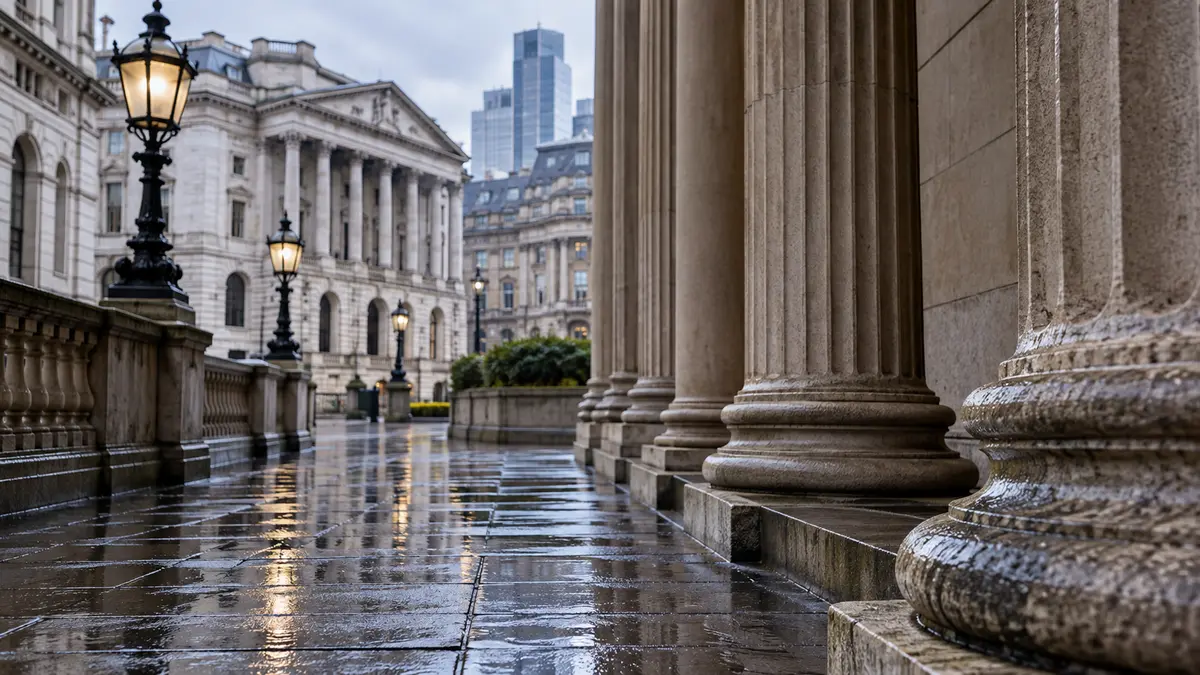
In the economic gloom of Labour's first year in power, the chancellor Rachel Reeves has had one reliable shred of comfort to cling to: five times since the general election of July 2024, the Bank of England has cut interest rates. This week that comfort is set to grow, as Threadneedle Street prepares what the City expects to be a sixth reduction in borrowing costs — a festive quarter-point cut on Thursday that the Treasury will be quick to seize upon. The view among bankers and investors is that the cut is odds-on, and the decision will land against a backdrop of weak growth, a cooling labour market and inflationary pressures that are finally fading. Yet the celebration will be short-lived, because attention will immediately shift to 2026 and to a harder question: how many more times can the central bank come to the chancellor's rescue?
That question matters far beyond Westminster. Monetary policy is the main lever the Bank has for steering the United Kingdom economy, and after three years of punitively high rates its decisions touch every mortgage, every business loan and every saver. The analysis below draws on the reporting of The Guardian to unpack what the sixth cut says about the state of the economy, why the monetary policy committee remains divided, and whether the disinflationary tailwind from the autumn budget can really deliver more relief next year.
A sixth cut lands in a sluggish economy
The immediate case for easing is straightforward. Last week brought disappointing October growth figures, and the jobs market and consumer prices data due out on Tuesday and Wednesday — before Thursday's rates decision — are expected to confirm that inflationary pressures in the economy are fading. After a year in which inflation repeatedly proved stickier than hoped, that confirmation would give policymakers the cover they need to act. A cut will be good news for businesses, for mortgage borrowers and for the beleaguered occupants of Downing Street, all of whom have spent the year absorbing the consequences of a weak economy.
That Britain's economy is in the doldrums should hardly come as a surprise. Continual speculation about tax changes has sapped business confidence and household spending, as firms and families postpone decisions in the hope of waiting out the next announcement. At the same time, Reeves's decision to increase employer national insurance contributions has fed through to hiring, playing a part in unemployment hitting the highest levels since 2021, during the height of the pandemic. In that context, celebrating a rate cut is a little like an arsonist cheering the arrival of the fire brigade: the relief is real, but it does not erase the damage that made the relief necessary.
There are, of course, factors beyond the chancellor's control. Not least among them is the dire state in which the Conservative party left the economy after fourteen years in office, with public services strained and growth anaemic. And then there is the external shock of Donald Trump's damaging tariff war, launched from the United States, which has disrupted trade flows, unsettled supply chains and added a layer of uncertainty to every business plan on both sides of the Atlantic. No British government could have insulated the economy fully from that storm, and the Labour administration has had to navigate it while also trying to rebuild fiscal credibility.
Three years of restrictive policy leave their mark
To understand why a sixth cut matters, it helps to remember how restrictive policy has been. After the inflation shock triggered by Russia's invasion of Ukraine sent energy and food prices soaring, the Bank raised its base rate to the highest level in a generation, peaking at 5.25 per cent in the summer of 2023. Threadneedle Street argues it had little choice but to act: choking off demand by incentivising saving and discouraging spending is the central banker's main tool for combating inflation. The strategy worked in the sense that price growth has come down from its double-digit peak, but the growth trade-off has been brutal, and it is still being felt.
Even after successive rate cuts, the Bank's own analysis shows the base rate continues to subtract about two per cent from the level of GDP. That is an enormous drag for an economy that desperately needs momentum. Anyone who has remortgaged their home since 2022 knows this first-hand: despite progress since the Liz Truss debacle of autumn 2022, when markets convulsed over an unfunded tax-cutting programme, millions of borrowers still face substantially higher loan repayments — and will continue to do so for years to come as fixed-rate deals expire and roll onto new, dearer terms. That is hardly going to light a match under a consumption-driven economy in which household spending is the main engine of growth.
The cumulative effect is a policy hangover that no single quarter-point cut can cure. Each reduction eases the margin a little, but the level of rates remains in territory that restrains activity, and the transmission of past tightening continues to work through the economy with a lag. For the Treasury, this creates a delicate political problem: rate cuts are welcome, but they arrive on top of a base that is still restrictive, so the relief felt by households is gradual rather than transformative. The Bank's task in 2026 will be to judge how quickly it can normalise policy without reigniting inflation — and that judgement is where the real disagreement lies.
Rate cuts travel through the economy along several channels at once. Variable-rate mortgages reprice almost immediately, while the large share of borrowers on fixed deals feel the change only when their contract expires, which is why the full effect of the easing cycle unfolds over several years rather than several weeks. Savings yields fall, nudging households toward spending rather than hoarding cash. Business loans become cheaper at the margin, encouraging the investment that has been postponed through the restrictive period. And a lower base rate tends to weaken the currency slightly, giving exporters a modest tailwind while making imports a touch dearer. None of these channels works instantly, and none works in isolation — which is precisely why the Bank insists on patience and why a single cut, however welcome, changes little on the ground from one month to the next.
A divided committee and a governor's casting vote
This week the Bank's policymakers are expected to be split on the appropriate way forward. Some on the nine-strong monetary policy committee recognise the damage that rates are doing at a time when inflation is cooling, and see no reason to keep policy tighter than it needs to be. Others think a tough approach is still warranted to snuff out price rises for good, worrying that easing too quickly would let inflation re-embed in wage settlements and service prices. The split is not new — votes have been close for much of the easing cycle — but it matters because it shapes the pace of cuts and the signals the Bank sends to markets.
Andrew Bailey, the Bank's governor, is expected to hold the casting vote, and his public remarks suggest where it will fall. Bailey has indicated that he thinks inflation is more likely to fall back than to stick at stubbornly high levels — a view that paves the way for a quarter-point cut on Thursday. The governor's framing is important: it tells markets that the committee's centre of gravity is shifting toward easing, even if individual members remain cautious. For borrowers, that message is worth almost as much as the cut itself, because expectations of further easing feed into swap rates and, ultimately, into the pricing of new mortgages and business loans.
The committee's structure shapes the debate. The nine members — the governor, three deputy governors, the chief economist and four external members drawn from academia and the private sector — meet eight times a year, and each brings a different reading of the data. External members in particular tend to voice the strongest dissenting views, and their votes are watched closely as a barometer of the committee's mood. Minutes published two weeks after each meeting reveal the balance of arguments, and it is in those minutes, as much as in the headline decision, that markets read the likely path of policy. A divided vote is not a sign of dysfunction; it is the normal state of a committee confronting genuine uncertainty about where the economy is heading.
Next year, however, it is tougher to anticipate how the committee will respond. Policymakers are likely to remain divided on two fundamental questions: the inflation outlook, and the so-called neutral position for rates — the level at which policy is neither stoking nor hosing down economic activity. Estimates of the neutral rate are uncertain and contested, and where a policymaker places it determines how far rates can fall before policy becomes stimulative rather than merely less restrictive. That uncertainty means the path of cuts in 2026 will be decided meeting by meeting, data release by data release, with little room for pre-commitment.

The budget's disinflationary bet
One reason the Treasury is quietly optimistic about 2026 is that Reeves's budget measures are designed to take pressure off prices directly. The package includes relief on energy bills, fuel duty, rail fares and prescription charges — all items that feed straight into the consumer prices index. The Bank predicts these policies could slash headline inflation by up to half a percentage point by the middle of 2026, a meaningful contribution at a time when every tenth of a point counts. For the monetary policy committee, that mechanical disinflationary effect could support the case for deeper cuts, because it lowers the inflation the Bank has to fight without any tightening of policy.
All of this was part of a deliberate strategy inside the Treasury, in the hope that voters will give credit to Labour for lower mortgage costs. If the budget's price relief and the Bank's easing cycle reinforce each other, the government can present a coherent story of falling living costs heading into the second half of the parliament. Government borrowing costs could also fall back as rate expectations adjust, unpicking some of the factors behind the recent years of fiscal drama in Westminster, when gilt yields spiked and debt-servicing costs ballooned. Cheaper borrowing for the state would ease the pressure on public spending plans and reduce the risk that another market wobble forces the chancellor into painful choices.
There is, however, a tension at the heart of this strategy. The same government that is counting on lower inflation is also raising costs elsewhere: business leaders warn that a higher minimum wage, higher business rates and other tax increases will drive up their costs, resulting in companies putting up prices for their customers and, in turn, stoking inflation. The net effect depends on which force dominates — the mechanical disinflation from energy and regulated prices, or the cost-push pressure from wages and taxes. Economists are split, and the Bank itself has flagged the risk that the reprieve could be temporary.
Why the reprieve may be temporary
Many economists warn that the relief on offer could prove short-lived, for a simple reason: much of the disinflationary impulse will come from energy prices, and energy does little to help with Britain's deeper problem of sticky service sector inflation. Services — everything from haircuts to hospitality to insurance — make up the bulk of the economy, and their prices have risen faster than goods prices for years, driven by wage growth and by firms passing on higher costs. A fall in the energy component of the index can flatter the headline number while leaving the underlying trend uncomfortably high.
The service sector accounts for roughly four-fifths of the British economy, which is why its price dynamics determine the overall inflation trend far more than goods prices do. Goods inflation has already fallen close to target levels and in places into negative territory, while services inflation remains markedly higher. Until that gap closes, the committee cannot confidently declare the job done. Moreover, services inflation is tightly linked to the labour market: as long as wages grow faster than productivity, firms in the sector will pass costs on to consumers, keeping the overall index above the Bank's two per cent target. That is the structural reason the hawks remain cautious even as the headline improves.
That is why the hawks on the committee remain wary. If service inflation stays elevated, cutting rates too quickly risks declaring victory prematurely, and the Bank's credibility — hard won after the inflation overshoot of 2022 and 2023 — would be damaged. The political economy makes this harder still: the government wants visible relief for households, the opposition attacks any sign of weakness, and the Bank must thread a needle between the two without appearing to take orders from either. The result is likely to be a cautious, data-dependent path in which each cut is earned by the numbers rather than promised in advance.
The hawks' case looks shaky
That said, some of the factors the hawks are betting on look shaky on closer inspection. Business costs are rising, but hardly at breakneck speed. The rise in the minimum wage from April — 4.1 per cent — is significantly below the increases of previous years, particularly when set against the context of 2022, when the then-chancellor Jeremy Hunt ignored misplaced warnings about a wage-price spiral and increased the legal pay floor by 9.7 per cent from April 2023. The economy absorbed that larger shock without a spiral taking hold, which suggests the current, smaller increase is unlikely to reignite one.
By the time spring arrives, there should be signs that inflation is undershooting the Bank's forecasts and that wage growth is slowing. The economy will probably still be lacking momentum, which in itself limits firms' ability to raise prices. Household confidence may be picking up as rate cuts feed through, but companies will probably lack the pricing power to push through yet more increases in a market where consumers remain cautious. Put together, these forces point toward a benign inflation outlook — and toward the possibility that Reeves could see more rate cuts from the Bank than sceptics currently expect.
What to watch in 2026
For readers trying to gauge how the story develops, a handful of indicators will matter most over the coming months:
- The path of headline inflation and, more importantly, service sector inflation, which reveals the underlying trend once energy swings are stripped out.
- Wage growth, both in the private sector and across the economy as a whole, since pay deals are the main engine of service price growth.
- The monetary policy committee's evolving view of the neutral rate, which sets the floor for how far cuts can go before policy turns stimulative.
- The measurable impact of the budget's energy and regulated-price relief on the consumer prices index through the first half of 2026.
- The labour market: whether unemployment continues to climb from its highest level since 2021, or stabilises as growth recovers.
- External shocks, above all the trajectory of the transatlantic tariff war and global energy prices, which can rewrite the inflation outlook overnight.
The Bank of England has already cut rates six times since the general election, and each cut has been a small but real relief for borrowers and for the government. The deeper question is whether the easing cycle has further to run, or whether sticky services inflation and cost-push pressures will force a pause. On the evidence available in December 2025, the balance of risks leans toward more cuts — but the committee remains divided, the neutral rate is uncertain, and the political stakes for both the Treasury and Threadneedle Street are high. How many more times the Bank will come to Rachel Reeves's rescue is, in the end, a question the data will answer, one meeting at a time.

















Leave a comment
Your comment is awaiting moderation.