Ruble Eases Against Yuan at Moscow Exchange as Oil Slides for Second Day
The Chinese yuan edged up at the Moscow Exchange on Thursday morning, with the ruble weakening against the backdrop of oil falling for a second consecutive day. Brent futures traded near $104.8 a barrel, while Russian annual inflation slowed to 6.27% as of September 14, according to Rosstat data.
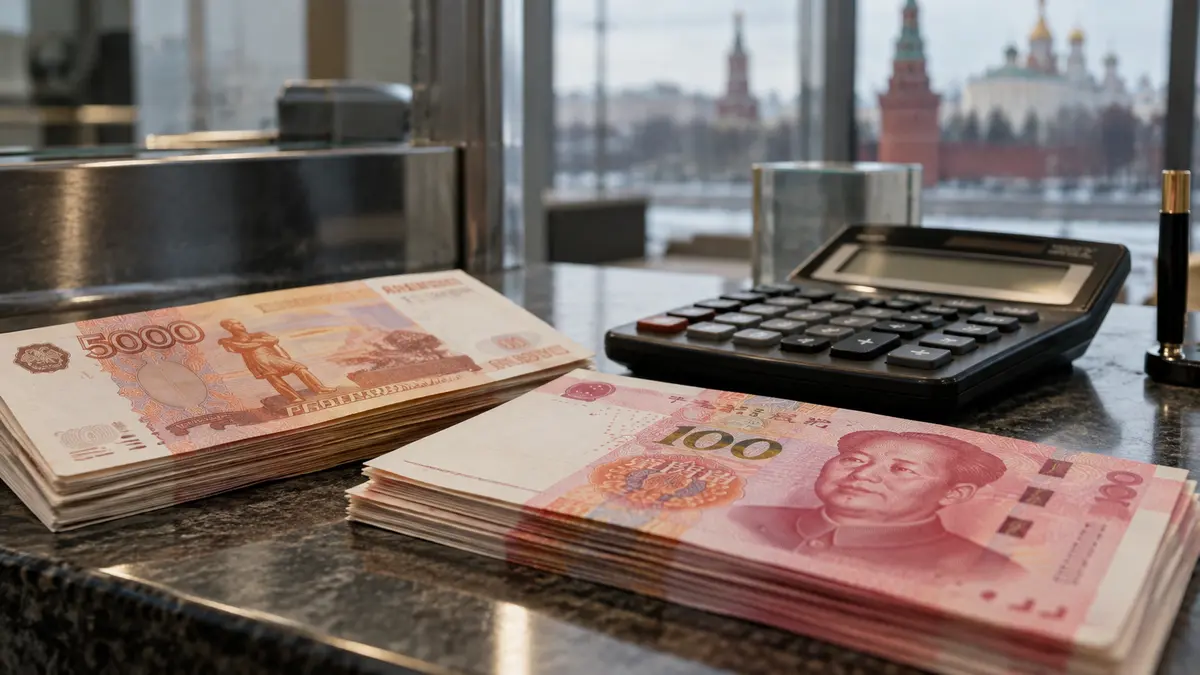
The yuan of China rose modestly at the Moscow Exchange as trading opened on Thursday morning, while the ruble weakened against the backdrop of oil prices falling for a second consecutive day. In the first minute of trading, the yuan stood at 12.592 rubles, up 1.45 kopecks from the previous session's close. The Chinese currency was also 4.63 kopecks above the level of the current official exchange rate.
Global oil prices continued to decline on Thursday morning after a notable drop the day before, driven by easing concerns over disruptions to fuel supplies from the Middle East. November Brent futures on the ICE Futures exchange in London traded at $104.82 a barrel as of 9:01 Moscow time, 0.95% lower than the previous session's close. On Wednesday they had fallen 2.7%, to $105.83 a barrel. October WTI futures on the New York Mercantile Exchange electronic trading system were down 0.96% at that point, at $101.45 a barrel, after dropping 3.2% in the previous session to $102.43 a barrel.
Oil under pressure from US inventory data
Pressure on oil prices was also coming from data published on Wednesday showing an unexpected rise in refined product inventories in the United States last week. According to the US Energy Department, commercial crude oil inventories in the country fell by 640,000 barrels over the past week, whereas analysts on average had expected a more substantial decline of 1.6 million barrels. Gasoline inventories rose by 794,000 barrels, and distillate inventories by 1.585 million barrels. Experts had forecast a 1 million barrel reduction in gasoline reserves and a 100,000 barrel increase in distillate stocks.
Consumer prices in Russia rose 0.02% over the week from September 8 to 14, following a 0.05% increase from September 1 to 7, a 0.01% decline from August 25 to 31, a 0.01% rise from August 18 to 24, and three consecutive weeks of falling prices: 0.02% from August 11 to 17, 0.06% from August 4 to 10, and 0.02% from July 28 to August 3, Rosstat reported on Wednesday evening. Data for the first 14 days of September this year and last imply that annual inflation in Russia slowed to 6.27% as of September 14, down from 6.33% at the end of August, when calculated from the weekly dynamics.

Fruit and vegetable products became 1.0% cheaper from September 8 to 14 after prices fell 1.8% the week before. Gasoline prices rose 0.36% over the period after a 0.58% increase the previous week (gasoline has risen 21.04% since the start of the year), while diesel fuel prices fell 0.33% after a 0.04% rise the week before (diesel has become 15.50% more expensive since the start of the year).
- Yuan at the Moscow Exchange open: 12.592 rubles, up 1.45 kopecks on the session and 4.63 kopecks above the official rate.
- Brent November futures: $104.82 a barrel, down 0.95%; WTI October futures: $101.45, down 0.96%.
- US commercial crude inventories fell 640,000 barrels, well below the expected 1.6 million barrel draw.
- Annual inflation in Russia slowed to 6.27% as of September 14 from 6.33% at the end of August.
Central Bank signals conditions for resuming rate cuts
The Bank of Russia will resume its cycle of cutting the key rate when it sees inflationary processes subsiding and underlying inflation declining, said Kirill Tremasov, adviser to the central bank governor. Speaking at the International Industrial and Energy Forum TNF-2026 in Tyumen, he said: "Going forward, this picture will be very important for our key rate decisions: how quickly inflationary processes begin to subside, how quickly underlying inflation begins to return to target levels again. That, in fact, will determine the length of this pause before we resume cutting the rate. In other words, we will be able to resume rate cuts when we see that inflationary processes are turning downward again."
Tremasov noted that at the beginning of the year the inflation picture resembled the one observed during the previous period of a VAT increase. "After the inflation spike at the start of the year linked to the VAT hike, we largely saw a repetition of the 2019 story, when there was also a spike followed by a sharp slowdown, and inflation remained low throughout the year. Right now a very similar picture has been forming. Already in spring we saw inflation slow down substantially, but the fuel crisis essentially shuffled the cards," the adviser to the central bank head said.
"Moreover, in the first phase of this crisis in June we saw exclusively rising fuel prices and a weak reaction in the underlying components of inflation. We saw sustained inflation acceleration begin in July and August. When we took the decision on September 11, we did not yet have the August inflation statistics. We received them on Friday evening. The figures confirm that underlying inflation, as we noted in the press release, has moved from the 4-5% range into the 5-6% range," Tremasov stressed.
The combination of a second day of falling oil, softer weekly inflation readings, and the central bank's cautious framing of the path back to easing leaves the ruble-yuan pair sensitive to both the energy market and the next batch of price data. Traders on the Moscow Exchange will be watching whether the yuan's modest morning advance extends as oil futures continue to drift lower.


















Leave a comment
Your comment is awaiting moderation.