The IPO Revival of 2025: Washington Wants to Make Going Public Cool Again
The first half of 2025 was the strongest start for U.S. IPO issuance since 2021, with 102 listings versus 78 a year earlier, and both deal count and capital raised surpassed full-year 2024. SEC chairman Paul Atkins now wants to make going public more accessible — cutting disclosure burdens, allowing arbitration and loser-pays bylaws, and curbing what he calls politicized activists — while NYSE president Lynn Martin hails a market that is strong across all sectors.
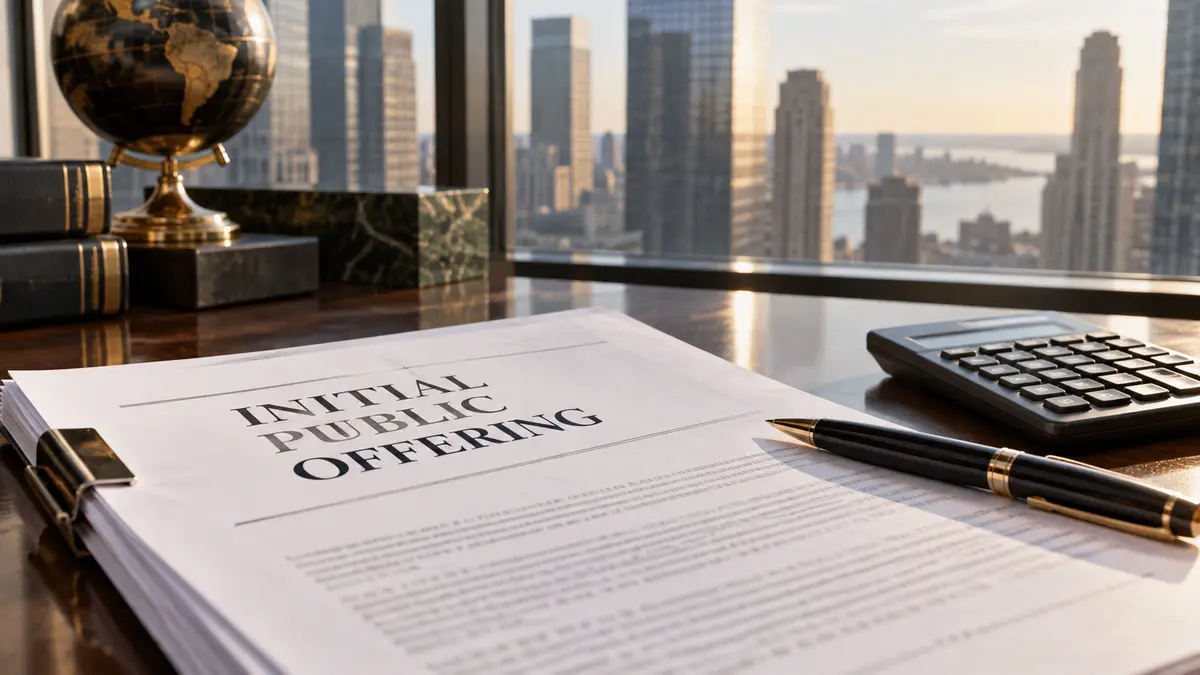
For much of the past decade, the initial public offering has looked like an endangered ritual of American finance. Companies stayed private longer, venture capital and private equity offered patient money without quarterly scrutiny, and the ranks of listed firms kept shrinking. Then 2025 arrived, and the listing window swung open with a force that caught even seasoned market watchers off guard. The first half of the year turned out to be the strongest start for U.S. IPO issuance since 2021, and by the autumn the revival had gathered enough momentum to push both deal counts and capital raised above the full-year totals of 2024. Now the country's top securities regulator wants to make sure the rebound becomes a lasting feature of the market rather than a fleeting upswing. Paul Atkins, the chairman of the U.S. Securities and Exchange Commission, has set himself an unusually blunt goal: to "make it cool to be a public company" again. This analysis looks at the numbers behind the 2025 IPO revival, the structural reasons the public company lost its appeal, the regulatory agenda Atkins has laid out, and what all of it means for investors, founders and the exchanges that depend on a steady flow of new listings.
A regulator with a sales pitch
Speaking earlier this week at the AICPA conference in Washington, D.C. — an annual gathering of accountants, auditors and financial preparers — Atkins framed his agenda not as a technical compliance exercise but as a campaign to restore the prestige of the public listing. Over the past thirty years, he noted, the total number of publicly traded companies in the United States has seen a significant net decline, driven in part by mergers and bankruptcies outpacing new listings. The appeal of going public, in his words, has "taken a hit over time." His stated goal is to reverse that trend by making the path to the stock exchange more accessible for issuers of every size.
Atkins identified three obstacles that he believes are holding issuers back. The first is the cost and length of disclosure: he described current reporting requirements as expensive and overly long, imposing an unnecessary burden on companies that list. The second is the threat of securities litigation, which he argued deters management teams from taking a company public at all. The third is what he characterized as "politicized shareholder activists" who can influence corporate governance battles in ways that distract boards from running the business.
On litigation, Atkins was notably concrete. He reiterated his support for allowing companies — where state law permits — to adopt bylaws that mandate arbitration of shareholder disputes and apply "loser pays" fee-shifting provisions, under which the losing side covers the other party's legal costs. Crucially, he said the SEC staff will no longer block an IPO solely because such measures are included in a company's charter. "If the state allows it, then that will be fine with us," he told the audience. On the activist front, he signalled that any related policy proposals would take most of next year to move through the regulatory process, setting expectations for a long rulemaking runway rather than a quick fix.
The numbers behind the rebound
The regulatory push comes at a moment when the market itself is already cooperating. According to S&P Global research, the first half of 2025 was the strongest start for U.S. IPO issuance since 2021, with 102 IPOs compared with 78 in the same period of 2024. Deal activity accelerated through the period: the second quarter alone saw 59 IPOs raising about $15 billion, up from 45 IPOs and $11.2 billion in the first quarter. Momentum carried into the third quarter, where EY reports that 23 U.S. deals raised $100 million or more, including five IPOs that each raised over $1 billion. Technology, media and telecommunications accounted for roughly one-third of those larger transactions and more than half of total proceeds — a reminder that the tech sector remains the engine room of the listing market. Overall, both deal count and capital raised in 2025 have already surpassed full-year 2024 levels, a milestone that would have seemed implausible to most bankers at the start of the year.
These figures matter beyond the obvious headline. A healthy IPO market performs several functions at once: it gives founders and early employees a way to convert paper wealth into cash, it provides venture and growth investors with an exit that recycles capital into new startups, it offers public investors access to companies at an earlier stage of their growth, and it supplies listed companies with a currency — their own shares — that can be used for acquisitions and employee compensation. When the listing window closes, all of those functions quietly atrophy, and the entire innovation funding chain becomes more dependent on a shrinking circle of private funds.
Why the public company lost its appeal
To understand why Atkins feels the need to campaign for the public listing, it helps to recall how the economics of going public changed over the past two decades. After a wave of accounting scandals in the early 2000s, the Sarbanes-Oxley Act of 2002 imposed sweeping internal-control and reporting requirements on listed companies. The compliance apparatus that followed — audit committees, internal control attestations, expanded disclosure — made being public materially more expensive, particularly for smaller firms with thinner administrative teams. A decade later, the Jumpstart Our Business Startups Act of 2012 tried to ease the burden for "emerging growth companies," allowing scaled disclosure and confidential draft filings, and it did help. But the deeper structural shift was elsewhere: private capital became abundant.
As venture funds grew larger and private equity firms accumulated record dry powder, startups discovered they could raise late-stage money privately at valuations that once required a public listing to justify. Staying private meant avoiding quarterly earnings pressure, activist scrutiny and the cost of running a public-company reporting machine. The result was the long decline in listed-company numbers that Atkins cited: mergers and bankruptcies removed companies from the exchange faster than new listings replaced them. Alongside the traditional IPO, alternative routes emerged — direct listings that skip the underwritten offering, and special purpose acquisition companies, the blank-check vehicles that briefly dominated deal flow in 2020 and 2021 before their own boom collapsed. Each alternative chipped away at the IPO's monopoly as the gateway to public markets.
There is also a cultural dimension. A generation of founders grew up watching public companies get punished by markets for investing in long-term growth, while private rivals burned cash without consequence. The perception that public markets reward short-termism — fairly or not — became part of the calculus that keeps boards private. Reversing that perception is harder than changing a disclosure form, and it is precisely the kind of soft problem that Atkins's "make it cool" framing is aimed at.

The exchange view
The New York Stock Exchange, which lives or dies by the flow of new listings, has been among the loudest cheerleaders of the revival. In a conversation with Fortune at the recent Fortune Most Powerful Women Summit, Lynn Martin, president of the NYSE, was unequivocal: "The IPO market is really, really strong. We've had a great year so far across all sectors." Her emphasis on breadth matters. A revival concentrated in a handful of mega-cap tech deals would be fragile; strength across sectors suggests the window is open for industrial, financial and consumer companies too.
Martin has also been candid about what still holds companies back. In an April LinkedIn post congratulating Atkins on his appointment, she wrote that she has "the great privilege of speaking frequently with CEOs and other senior executives of companies around the globe," and that while each company is unique, she hears a similar refrain: the complexity and cost of meeting the regulatory requirements of public companies is onerous, and represents a disincentive for private companies considering an IPO. At the same time, she defended the broader model, arguing that U.S. capital markets are "unmatched in their ability to foster economic growth, empower companies, and create long-term wealth opportunities for investors." That dual message — celebrate the market, fix its frictions — is now effectively the consensus position of both the regulator and the exchange.
What deregulation can and cannot fix
Atkins's agenda raises legitimate questions about where the line sits between reducing friction and weakening investor protection. Disclosure exists for a reason: public investors are entitled to the information they need to price risk, and the reporting regime that developed after the accounting scandals of the early 2000s was a response to real failures. Trimming genuinely redundant or duplicative requirements is widely supported across the industry; gutting the substance of disclosure would be a different matter, and one that could raise the cost of capital rather than lower it if investors demand a premium for opacity. The SEC's own mandate — protecting investors while facilitating capital formation — requires walking that line carefully.
The litigation proposals are equally contested. Mandatory arbitration and "loser pays" provisions would likely reduce the volume of shareholder suits, including the strike suits that plaintiffs' lawyers file after any sharp share-price move. Supporters argue that such suits tax honest companies and enrich litigators; critics counter that the threat of litigation disciplines management and gives dispersed shareholders their only realistic remedy when governance fails. Fee-shifting, in particular, can deter meritorious claims by individual investors who cannot risk paying the other side's fees. Atkins's decision to stop blocking IPOs that include such bylaws shifts the balance toward issuers, and the coming rulemaking on activist-related proposals will test how far the commission is willing to go.
It is worth noting what regulation cannot do. No rule change can manufacture investor appetite, and the 2025 revival owes at least as much to market conditions — steadier rates, resilient earnings and renewed risk tolerance — as to any policy shift. The window opened because buyers returned, and it will stay open only as long as new listings price well and perform after the pop. Regulators can lower the tollbooth; they cannot guarantee the traffic. This distinction matters for how the debate is framed: supporters of the agenda point to the measurable burdens of being public — audit fees, legal costs, management hours consumed by reporting — while sceptics note that the most successful companies of the past two decades found ways to thrive under exactly those rules, suggesting that the friction argument can be overstated when the underlying business is strong enough to absorb it.
There is also an international dimension worth watching. Listing activity is competitive: companies choose where to list, and exchanges in other financial centres have spent years courting the same pool of candidates with their own incentives and lighter-touch regimes. If the American market becomes meaningfully cheaper and faster to enter without losing the depth of its investor base, it strengthens the position of U.S. exchanges in that global competition; if the reforms are perceived as tilting too far toward issuers, some institutional investors may question whether the protections that made American listings the gold standard are being diluted. The balance Atkins strikes will therefore be read not only in Washington but in boardrooms and fund offices around the world.
The bankers' quiet comeback
Behind every revival of listings there is an industry that profits from them: the investment banks that underwrite new issues. During the drought years, equity capital markets teams were trimmed and reassigned; the revival of 2025 has brought them back to the centre of the deal machine. For banks, a busy IPO calendar means underwriting fees, follow-on offerings and a pipeline of future advisory work. For issuers, the return of competition among underwriters means better pricing, broader distribution and more honest advice about whether the window is truly open. The symbiosis is old and well understood: banks need deals, companies need distribution, and investors need a steady supply of new names to choose from. When all three align, the market functions; when any one falters, the window narrows.
There is also a retail dimension worth noting. New listings are one of the few moments when ordinary investors can buy into a company at the same price as institutions, before years of private-market appreciation have already been baked in. The long decline in listings meant that much of the value creation in technology and other growth sectors accrued to venture funds and their limited partners, while the public markets offered mainly mature companies. A sustained revival would begin to reopen that door — though it would also reopen the familiar risks of first-day pops, lock-up expirations and the volatility that comes with newly listed shares finding their price.
What a durable revival would look like
For the 2025 rebound to become structural rather than cyclical, several things would need to hold. First, breadth: the pipeline would need to keep drawing from beyond the technology sector, so that the market does not depend on a single theme. Second, aftermarket performance: investors who buy new listings need to see those stocks hold up, because a string of post-IPO disappointments closes the window faster than any regulator can open it. Third, a stable macro backdrop, since listing activity is acutely sensitive to rate expectations and volatility. And fourth, a regulatory settlement that reduces genuine burdens without eroding the transparency that makes public markets trustworthy in the first place.
- Strongest first half for U.S. IPO issuance since 2021: 102 listings versus 78 a year earlier, per S&P Global.
- Acceleration through the year: 45 IPOs raising $11.2 billion in Q1, then 59 IPOs raising about $15 billion in Q2.
- Third-quarter depth: 23 U.S. deals of $100 million or more, including five billion-dollar-plus IPOs, per EY.
- Sector concentration: technology, media and telecommunications made up roughly one-third of large Q3 deals and more than half of proceeds.
- Full-year milestone: 2025 deal count and capital raised have already surpassed the entirety of 2024.
Outlook for 2026
As 2026 approaches, the stakes are high to keep this year's IPO revival from being just a fleeting upswing in the public markets. Atkins's rulemaking on disclosure, litigation and activism will unfold over the coming year, and each proposal will draw fire from both sides of the investor-protection debate. The exchanges, meanwhile, will keep courting the large private companies that have long deferred their listings, hoping that a combination of market warmth and regulatory relief finally persuades the most prominent holdouts to ring the bell. For founders, the message of 2025 is that the window is open — but windows in capital markets have a habit of closing without notice, and the companies that benefit most are usually the ones that were prepared before the weather changed. For investors, the revival is an opportunity and a test at once: new listings offer early access to growth, but they also demand the discipline to distinguish durable businesses from stories priced for perfection. The coming year will show whether the public company has genuinely regained its appeal, or whether 2025 was simply the market catching its breath.
















Leave a comment
Your comment is awaiting moderation.