Japan's Silicon Trap: How Semiconductor Dependence Masks a Broader Economic Malaise
Japan's economy grew just 1.0% in 2025, halving from 2.0% the previous year, yet semiconductor output surged 13.2% and chips contributed nearly a full percentage point to export growth. The divergence between a booming chip sector and contracting non-chip manufacturing — what commentators call the 'silicon trap' — raises fundamental questions about the sustainability of Japan's growth model as the Bank of Japan normalises policy and demographics continue to bite.
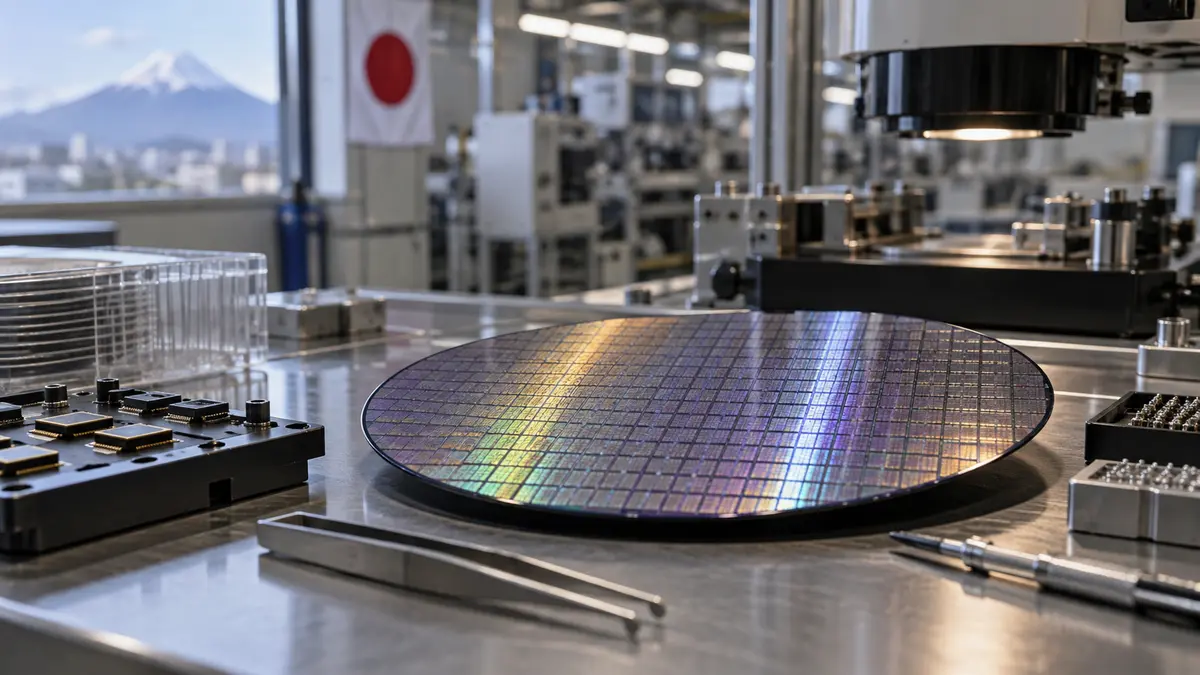
Japan's economy delivered a paradox in 2025. Headline growth of 1.0% — half the 2.0% recorded in 2024 — suggested an economy losing momentum. Yet beneath that aggregate figure lay a sector performing with extraordinary dynamism: semiconductor output surged 13.2%, chips contributed an estimated 0.9 percentage points to export growth, and the Bank of Korea's counterpart data showed that in the first quarter of 2026 semiconductor manufacturing alone accounted for nearly half of Japan's GDP expansion. This is what Japanese economic commentators have begun calling the country's "silicon trap" — a growth model increasingly dependent on a single sector whose strength masks broad-based weakness everywhere else.
The growth picture in detail
The quarterly path of 2025 tells a story of volatility rather than steady decline. GDP contracted 0.2% in the first quarter, expanded 0.7% in the second, accelerated to 1.3% in the third — the fastest pace in approximately eighteen months — before contracting again by 0.2% in the fourth quarter on weak facility investment and a construction slump. The full-year result of 1.0% was technically positive but represented a halving of the previous year's pace and left per-capita gross national income rising by just 0.3% to $36,963.
- Full-year 2025 real GDP growth: 1.0% (down from 2.0% in 2024)
- Q1 2025: −0.2% q/q; Q2: +0.7%; Q3: +1.3%; Q4: −0.2%
- Exports: +4.2% year on year, led by semiconductor demand
- Semiconductor output: +13.2% in 2025
- Non-chip manufacturing: slipped into contraction
- Per-capita GNI: $36,963, up just 0.3%
- Construction investment: sharp decline, the primary domestic drag
- Q1 2026 preliminary: +1.7% q/q, fastest in five and a half years

Anatomy of the silicon trap
The concentration of growth in semiconductors is not merely a statistical curiosity — it represents a structural vulnerability. When a single sector accounts for nearly half of quarterly GDP expansion, the economy becomes hostage to that sector's cycle. Semiconductor demand is notoriously volatile, driven by capital expenditure cycles in data centres, consumer electronics refresh rates and, increasingly, by artificial intelligence infrastructure buildouts. A downturn in global chip demand — whether cyclical or driven by overcapacity — would remove Japan's primary growth engine with no obvious replacement.
The trap has several dimensions. First, the wealth generated by semiconductor exports is not evenly distributed. Chip fabrication is capital-intensive rather than labour-intensive, employing relatively few workers per unit of output compared with the automotive, electronics assembly and machinery sectors that have traditionally driven Japanese employment. Second, the strength of the chip sector has attracted investment and policy attention away from other manufacturing industries, creating a crowding-out effect at precisely the moment those industries need modernisation. Third, the concentration makes the economy more vulnerable to geopolitical shocks — export controls, technology restrictions or demand shifts driven by US-China competition could disrupt the sector far more quickly than domestic policy could respond.
The broader manufacturing picture
Outside semiconductors, Japanese manufacturing in 2025 was under pressure from multiple directions. The automotive sector, historically the backbone of Japanese industry, faced intensifying competition from Chinese electric vehicle manufacturers in both domestic and export markets. Steel and chemicals grappled with high energy costs that remained elevated after the loss of cheap Russian supplies. Machinery orders — a leading indicator of business investment — were volatile and trended downward through the second half of the year.
The construction sector was the most significant domestic drag. Investment fell sharply as the property downturn that began in 2022 continued to suppress new projects, and a labour shortage in the sector — exacerbated by the 2024 overtime regulations that capped working hours for construction workers — constrained activity even where demand existed. The combination of weak construction, stagnant non-chip manufacturing and cautious household spending produced an economy that grew only because net exports carried the burden.
Monetary normalisation and its discontents
The Bank of Japan's policy trajectory during 2025 added another layer of complexity. Having exited negative interest rates in March 2024, the BOJ raised its policy rate to 0.5% in January 2025 — the highest since 2008 — and held there for most of the year before hiking to 0.75% in December. Governor Kazuo Ueda cited sustained wage growth and the achievement of the 2% inflation target as justification, but the timing was delicate: raising rates into an economy growing at just 1% risks tipping it into contraction.
The transmission mechanism operates through several channels. Higher rates increase mortgage costs for households, reduce the present value of future corporate earnings, and strengthen the yen — which helps importers but hurts the exporters who are the primary engine of growth. For the semiconductor sector specifically, a stronger yen reduces the yen-denominated value of overseas sales, potentially dampening the very sector on which the economy has become dependent. The BOJ's December hike was passed 7-2, with two board members dissenting on the grounds that global trade uncertainty warranted a more cautious pace.
Wage growth: the missing link
The theoretical path out of the silicon trap runs through domestic demand — specifically, through wage growth strong enough to generate a self-sustaining consumption cycle. The 2025 shunto spring wage negotiations delivered the largest increases in thirty-three years, with major manufacturers agreeing to raises averaging over 5%. Yet real wages — adjusted for inflation — remained flat or slightly negative for much of the year, because price growth absorbed the nominal gains.
The problem is structural. Japan's labour force is shrinking by approximately 400,000 people per year due to demographic decline, which should in theory create upward wage pressure through scarcity. But the economy's low productivity growth — particularly in services, which employ the majority of workers — means that wage increases are not matched by output gains, creating a cost-push dynamic that feeds inflation without improving living standards. Until productivity growth accelerates outside the semiconductor sector, wage-driven domestic demand will remain insufficient to replace export-led growth.
The 2026 outlook and policy choices
Early 2026 data offered a glimmer of hope. First-quarter GDP expanded 1.7% quarter on quarter — the fastest pace in five and a half years — with semiconductor manufacturing accounting for nearly half the expansion. The Bank of Japan raised its 2026 growth forecast to 2.6% in May, citing a "semiconductor supercycle" driven by AI infrastructure demand. The government's Ministry of Economy, Trade and Industry projected 2% growth, betting on continued chip strength and a rebound in construction investment.
But these forecasts embed the very concentration risk that defines the silicon trap. If the AI-driven chip cycle continues, Japan grows at 2% or more and the trap remains comfortable. If the cycle turns — as semiconductor cycles historically always do — the economy has no alternative engine of comparable scale. The policy challenge for Tokyo is to use the current chip boom as a window of opportunity to invest in broader productivity: digitalisation of services, automation of construction, reform of agricultural and healthcare sectors, and reintegration of underutilised labour. Whether the political system can sustain that investment horizon beyond the next electoral cycle remains the defining question for Japan's economic future.
The investment paradox
Japan faces an investment paradox that deepens the silicon trap. The semiconductor sector attracts enormous capital — government subsidies under the Economic Security Promotion Act, private investment from TSMC"s Kumamoto fab and Rapidus"s Hokkaido project, and foreign direct investment from chip equipment makers — while the rest of manufacturing struggles to attract funding at all. Business fixed investment outside semiconductors declined in 2025, and the ratio of investment to GDP remained below the OECD average for the third consecutive year. The paradox is that the very success of semiconductor policy — which has made Japan an attractive destination for chip investment after decades of decline — simultaneously starves other sectors of the capital they need to modernise.
This dynamic has historical echoes. In the 1970s and 1980s, Japan"s Ministry of International Trade and Industry successfully targeted steel, shipbuilding and automobiles, creating globally dominant industries. But the concentration of policy attention and capital in targeted sectors came at the expense of services, agriculture and domestic-oriented manufacturing, which remained protected and uncompetitive. When the bubble burst in 1991, it was the non-tradable sectors — construction, retail, banking — that dragged the economy into three decades of stagnation. The current semiconductor concentration risks creating a similar asymmetry: a world-class chip industry sitting atop an economy whose domestic sectors remain underinvested and unproductive.
Demographics as the binding constraint
No analysis of Japan"s economic trajectory is complete without addressing demographics, which remain the single most powerful constraint on growth potential. The working-age population peaked in 1998 and has been declining ever since; the total population began falling in 2008 and is now shrinking by approximately 800,000 people per year. By 2040, Japan will have approximately 11 million fewer workers than in 2020, with the elderly dependency ratio rising to one retiree for every two working-age adults.
Demographics affect the silicon trap in several ways. First, they limit the domestic market for non-export industries, reinforcing dependence on external demand. Second, they create labour shortages that push wages up in sectors like construction, nursing and logistics without corresponding productivity gains, generating cost-push inflation that erodes real incomes. Third, they constrain the fiscal space available for industrial policy: as social security spending rises automatically with the ageing population, less revenue is available for productive investment in education, infrastructure and technology diffusion. The semiconductor sector is partially insulated from these constraints because chip fabrication is highly automated and attracts global talent, but the broader economy in which it is embedded is not.
Japan"s response has been incremental rather than transformational. Immigration has increased modestly — the foreign resident population reached a record 3.4 million in 2024 — but remains far below levels needed to offset natural population decline. Female labour force participation has risen significantly over the past decade but remains below male participation, particularly in senior roles. Automation and robotics offer the most promising path, but deployment outside manufacturing remains limited. None of these measures, individually or combined, is sufficient to reverse the demographic trajectory within the timeframe that matters for current policy decisions.
Conclusion: managing the trap
The silicon trap is not a crisis — it is a vulnerability. Japan"s semiconductor boom is a genuine achievement, the product of decades of accumulated expertise in materials, equipment and process engineering that few countries can replicate. The trap lies not in the strength of the sector but in the weakness of everything around it. An economy that grows at 2% when chips are booming and contracts when they are not is an economy with a single point of failure.
The policy challenge is therefore not to choose between semiconductors and other sectors — that would be self-defeating — but to use the fiscal space and confidence generated by the chip boom to invest in broader productivity. The window is narrow: semiconductor cycles typically last three to five years, and the current AI-driven upcycle began in 2023. If Japan does not use the next two to three years to build alternative sources of growth, it will face the next downturn with the same structural weaknesses it has today, minus the buffer that the chip boom currently provides. The silicon trap, in other words, is ultimately a question of time — and time, in a demographically declining economy, is the scarcest resource of all.
The international dimension adds urgency. South Korea faces a similar silicon concentration, with semiconductor manufacturing accounting for nearly half of its first-quarter 2026 GDP growth. Taiwan"s economy is even more dependent on a single company, TSMC. If all three East Asian chip powerhouses are simultaneously concentrated in the same sector, a global semiconductor downturn would hit the region"s three largest advanced economies at once, with contagion effects through supply chains, financial markets and trade flows that no individual government could offset. Regional coordination on industrial diversification — difficult in the best of times given competitive dynamics — becomes a shared vulnerability that the current boom obscures but does not eliminate.
For investors and policymakers watching Japan, the key indicator to monitor is not headline GDP but the ratio of semiconductor exports to total exports, and the growth rate of non-chip manufacturing output. When that ratio stabilises or declines while overall growth holds, it will signal that Japan has begun to escape the trap. Until then, the silicon boom is a blessing that carries within it the seeds of a future problem — and the wisdom of Japanese policy will be judged by whether it recognised the difference in time.
















Leave a comment
Your comment is awaiting moderation.